




One of the things I want to eat when I go to Okinawa is sea grapes!
That popping texture is just so delicious.
By the way, what exactly are sea grapes?
Well, I can't help but be curious, so I guess I'll just have to investigate!
This time, we visited a sea grape farm in Okinawa and learned all sorts of things about sea grapes, including delicious ways to eat them.
<Table of Contents>
1. What are sea grapes?
2. Delicious ways to eat sea grapes
3. The site of sea grape cultivation
3-1. Visiting the Sea Grapes Cultivation Site
3-2. Finally, a tasting of sea grapes.
4. If you want to buy sea grapes cheaply
5. Conclusion
1. What are sea grapes?
The official name for sea grapes is Caulerpa lentillifera. It is a type of seaweed found in warm seas, including Okinawa, Australia, and Hawaii.
Although it is widely distributed, natural colonies only exist in a part of Miyako Island, and most of what we usually eat is farmed.
Within Japan, Okinawa (with Onna Village and Kumejima being the main production areas) is number one in aquaculture production.
The name "sea grapes" comes from its appearance; the small, bead-like green bumps that grow in clusters on vines resemble grapes.
It is also sometimes called green caviar.
They are sensitive to temperature; they can't handle it if it's too hot, and they can't handle it if it's too cold.
This is important, so I'll say it first:If you buy sea grapes, "do not put them in the refrigerator.".
The ideal temperature is 15-28°C, so it's best to keep it in a cool, shady spot indoors.
If you put them in the refrigerator, the water will drain out and they will shrivel up, losing that popping texture.
2. Delicious ways to eat sea grapes

Sea grapes in their best condition, with their delightful popping texture and subtle saltiness.
Later, I'll tell you about the sea grape farm on Kumejima Island, but first, let me tell you about the delicious way to eat sea grapes that I learned about there.
2-1. Serve sea grapes as they are, dipped in a vinegar-based sauce or other dipping sauce.
First, keep it simple and don't try anything too fancy. Since it will shrivel up if left soaking in seasonings for too long, I don't recommend making it ahead of time.
2-2. Salad
Salads are a common choice, but instead of using sea grapes as a topping, let's enjoy them to the fullest with sea grapes as the main ingredient.
It's also great paired with tuna, or sprinkled with refreshing bonito flakes!
2-3. Mix sea grapes with natto.
This is a dish that you can somehow imagine tasting delicious. I'd love to mix in a raw egg and slurp and pop it up.
2-4. Yamakake & Sea Grapes
It has some similarities to natto (fermented soybeans), but it also goes well with yam gravy! The addition of tuna makes it a perfect accompaniment to alcoholic beverages.
2-5. Sea grapes and avocado with Korean seaweed
Sea grapes pair well with rich ingredients! You can also use cream cheese instead of avocado.
You can also roughly chop everything up and mix it with salted kelp and sesame oil; that's delicious too.
It works great as a side dish for oily meat and fish dishes such as braised pork belly or mackerel!
3. The site of sea grape cultivation
My long-held dream of one day eating a huge pile of sea grapes finally came true when I went to Kumejima, a major producer of sea grapes!
Kumejima Deep Sea Water Development Co., Ltd., which cultivates and produces sea grapes, is located just a 2-3 minute drive from Eef Beach, the central area of Kumejima Island.
At Kumejima Deep Sea Water Development Co., Ltd., we were given a tour of their sea grape cultivation site.
3-1. Visiting the Sea Grapes Cultivation Site
In one corner of the coastal area, greenhouses are lined up. Inside the greenhouses, many fish tanks are arranged.

Looking into the fish tank, I saw... sea grapes growing profusely!
The sea grapes are swaying gently in the water.
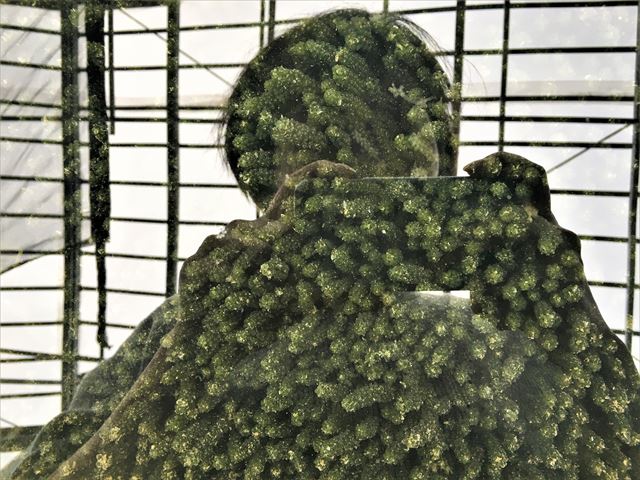
I was given a brief explanation of how sea grapes are cultivated.
Place the sea grape seedlings on a mesh net.

Spread it out with a washer.

Secure the seedlings by sandwiching them between the same netting. Then, place this in the water.
The plant then takes root in the net, and once the net is removed after being held down from above, it continues to grow rapidly.
The white part is the root of the sea grape.
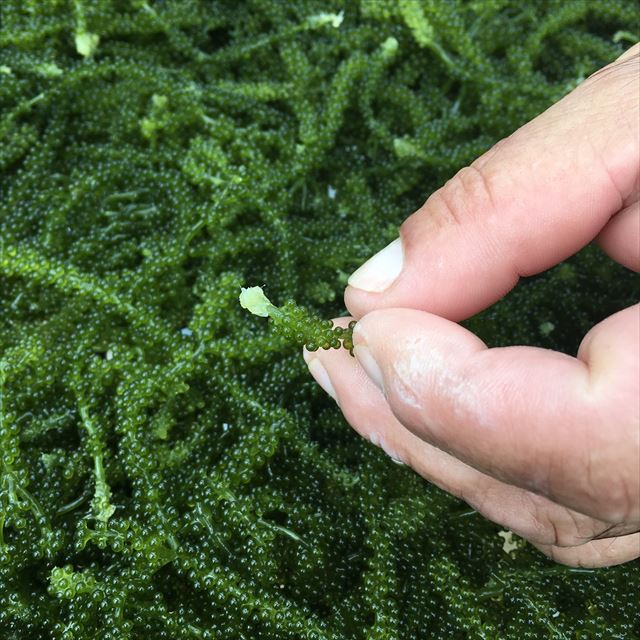
It's very simple, but this is only possible thanks to Kumejima's famous deep-sea water.
Deep-sea seawater is said to be suitable for cultivating sea grapes because it contains few impurities, is rich in minerals, and is kept at a low temperature.
Since sea grapes are a type of seaweed, the parts that are exposed to sunlight are green, while the parts that are not exposed to sunlight are whitish.
Even if the sea grapes you bring home turn whitish, apparently they'll turn green again if you expose them to sunlight.
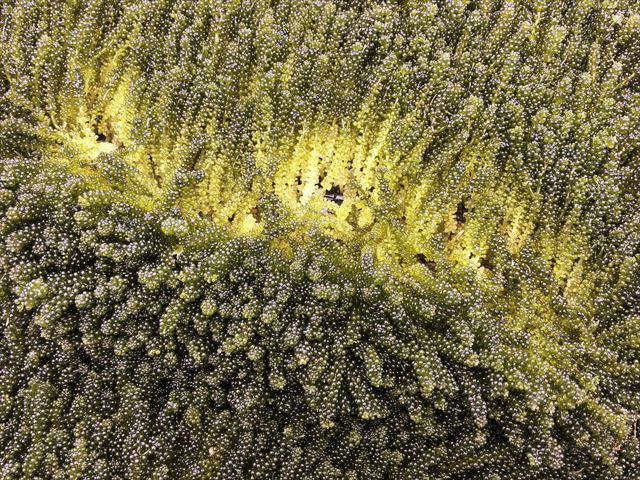
They will be large enough in about 30 days.

When sea grapes are ready for harvest, the branched parts are manually pruned to create a uniform shape.
Now that I think about it, sea grapes are always neatly arranged in a straight shape, but I didn't realize that this kind of manual work was involved.

I joined the staff in participating in the pruning work.
Grabbing the sea grapes in the tank

I'll pull them out with a snapping sound.

Pull them out and place the sea grapes in a plastic case, then trim off any excess parts from each one to make them neater.
After this, they undergo washing and other processes before being shipped to various locations.
3-2. Finally, a tasting of sea grapes.
I was given a sample of sea grapes to try before I left.
"!"
It has incredible elasticity, and the texture is more than just popping; it's crunchy.
And the sea grapes with sauce are also delicious. This is truly a case of "you can't stop eating it."
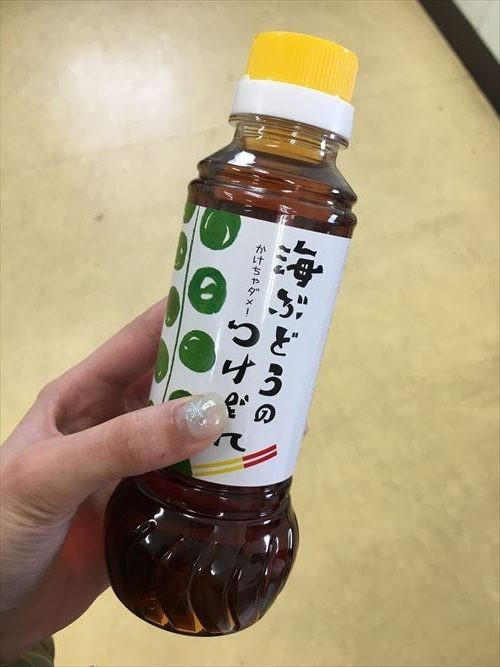
The dipping sauce for the sea grapes was flavorful and delicious, but the best part was definitely the texture of the fresh sea grapes.
4. If you want to buy sea grapes cheaply
You should aim for roadside rest areas or local supermarkets. You can definitely buy things cheaper there than at souvenir shops.
If you're looking for something near Naha Airport, I recommend the roadside station in Itoman!
If you buy sea grapes, don't put them in the refrigerator.
4. Conclusion
Thinking about sea grapes has made me want to eat some right away.
The next time I go to Okinawa, I'd like to enjoy sea grapes again.
Articles from the same area
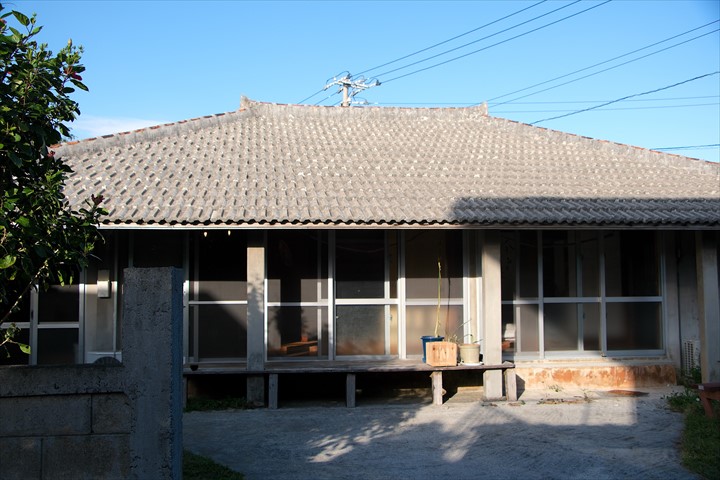 Homestay limited to one group per day. A special time woven in a traditional house on Kumejima Island: "Guesthouse Sou" accommodation experience
 I went diving in Kumejima, one of Okinawa's top diving areas!
 Okinawa's remote islands! A complete guide to the hugely popular Kerama Islands!
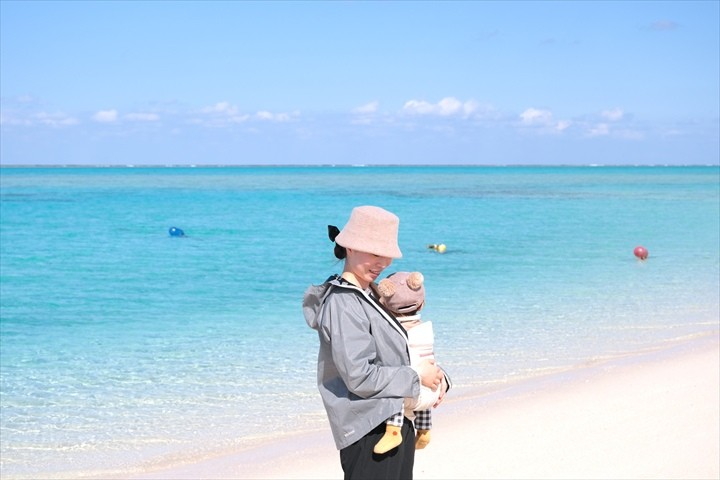 Relax with your family! A travel guide to Kumejima Island, perfect for those traveling with babies.
 We finished three bottles of wine! We had island Italian food at "café Shimamun+" on Tokashiki Island.
 Seven unique and slightly unusual tourist spots that will make you a Kumejima expert!
Articles on the same topic
 Explore Kumejima Island on a leisurely bike ride! Discover the island's charm from a bicycle perspective.
 A fan of Okinawan soba tried comparing different cup noodle versions of Okinawan soba!
 What kind of place is "Himeyuri Tower"? A place to visit and confront Okinawan history.
 What is peace? A journey to the Peace Memorial Park to feel and contemplate the meaning of peace.
 I tried 10 different kinds of bottled "Sanpin Tea"!
 A true story from the perspective of a wife who moved to Okinawa! Funny and relatable stories from Okinawa.