
 Hello, welcome, thank you very much.
Encountering the Okinawan dialect, "Uchinaguchi," while traveling can really enhance your Okinawan experience. The longer you stay, and the more you fall in love with Okinawa, the more you'll want to use Uchinaguchi—that's part of its charm, I think.
For all you Okinawa lovers out there, here's a challenge from Okinawa Lab! Learn to "see," "hear," and "use" Uchinaguchi (Okinawan dialect) while you're traveling.
How many do you know?
If you answer all the questions correctly, you'll be considered an Okinawa enthusiast!?
Try tackling the problems together and have fun comparing your answers!
<Table of Contents>
1. [Question 1] Okinawan dialect words to "see" while traveling
2. [Question 2] Okinawan dialect to "hear" while traveling
3. Mini Column | Uchinaguchi? Shimakutuba?
4. [Question 3] Greetings in Okinawan dialect
5. [Question 4] Communicate in Okinawan dialect
6. [Question 5] Introduce yourself in Okinawan dialect.
7. Enjoy using Okinawan dialect!
1. [Question 1] Okinawan dialect words to "see" while traveling
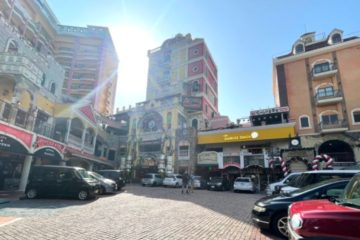
First, here's a question about Okinawan dialect, which you've probably seen at Naha Airport, Kokusai Street, and other famous tourist spots.
Do you know the meaning of the following words?
 Q1. Welcome!
Q2. Nifeedeebiru
Q3. Champuru
Q1 Answer: Mensore | Welcome
It's a phrase used to welcome someone, conveying a sense of welcome.
Originally, it meant "Please come in," but now it's used with the nuance of "Welcome!" or "Come on in!"
Q2 Answer: Nifeedeebiru | Thank you
This is a polite way to express gratitude. "Nifee deebitan" is the past tense of "thank you very much." It's one of the Okinawan words you'll want to use a lot while traveling.
Q3 Answer: Champuru | Stir-fry / Mixed
"Champuru" is a general term for stir-fried dishes made by frying vegetables and tofu in oil. It also means "mixed together" and is sometimes used in contexts other than cooking.
When people hear the word "champuru," many probably think of goya champuru (bitter melon stir-fry).
2. [Question 2] Okinawan dialect to "hear" while traveling
Next up is a question about a word that's now being heard outside of Okinawa Prefecture. Surprisingly, many people might be misunderstanding its true meaning!
Q1. Everything will be alright.
Q2. Ichariba Chode
 Q1 Answer: Nankurunaisa | It'll all work out somehow
The phrase "Nankuru nai sa" (meaning "everything will be alright") does not mean "it's okay to be careless."
"Nankuru naisa" originally comes from the idiomatic expression "makutu soke nankuru naisa," which means "everything will be alright if you do the right thing."
In other words, it's based on the premise of putting in consistent effort every day, and it's not meant to imply that it's okay to be careless.
When you understand its true meaning, it's a warm and comforting phrase that's very typical of Okinawa, making you feel at ease while also encouraging you to "pull yourself together!"
Q2 Answer: Ichariba Chode | Once we meet, we're all brothers and sisters.
This is a very famous Okinawan proverb.
Once you meet them, it's like becoming brothers and sisters. When traveling in Okinawa, you'll often be surprised by how kind people are, and you'll be soothed by their warm smiles and the pleasant atmosphere.
Perhaps that's because the spirit of "Ichariba Chode" (once we meet, we are sworn brothers and sisters) is deeply rooted in the people of Okinawa.
3. Mini Column | Uchinaguchi? Shimakutuba?
 This article refers to the language (dialect) used in Okinawa as "Uchinaguchi," and introduces the language mainly spoken on Okinawa Island.
But did you know that there are actually many words to refer to the language spoken in Okinawa?
"Uchinaguchi," "Shimakutuba," "Myakufutsu"—these are not simply different ways of pronouncing things.
Okinawa Prefecture is comprised of 160 islands. While it's easy to refer to it all as "Okinawa," each island and region has its own unique culture, and there are just as many diverse languages as there are islands.
Nowadays, we can travel in an instant by plane, but in the days when crossing the sea by ship was a life-threatening endeavor, it's understandable that each island and region developed and preserved its own unique language and culture.
 Therefore, even within Okinawa, it's quite common for the language to change completely depending on the location. This is what makes Uchinaguchi so profound.
In recent years, thanks to proactive efforts to preserve the Okinawan language, which was on the verge of disappearing, the charm of the language remaining not only on the main island but also on the outlying islands is being re-evaluated.
Language is born, and culture is born.
Learning a language helps you understand history.
Using words makes you love the place even more.
A sudden interest in "Uchinaguchi" (Okinawan dialect) that you encounter during your travels might reveal a side of Okinawa you never knew before. Wouldn't a trip to Okinawa that begins with a word be wonderful?
4. [Question 3] Greetings in Okinawan dialect
Now, the difficulty level increases. How would you translate the following words into Okinawan dialect?
Let's start with some warm-up exercises!
 Q1. Hello
Q1 Answer: Hello | Haisai (male) / Haitai (female)
Was it too easy?
It's a friendly phrase that can be used anytime—morning, noon, or night—similar to "Hello/How are you?/Thanks!". If you knew that the way it's said differs depending on whether you're male or female, you're quite the Okinawa expert!
In casual settings, you would simply use "Haisai (Haitai)," but in more formal situations or when speaking to superiors, you would use the more polite expression "Haisai chūganabira (Hello, how are you?)."
5. [Question 4] Communicate in Okinawan dialect
Q1. Delicious
Q2. Thank you for the meal.
Q3. Like/Great
 Q1 Answer: Delicious | Ma-san
It means "delicious food" and is a word that expresses gratitude for food. The nuance can also be changed by the ending, such as "ma-san-do" (= it's delicious) or "ma-san-ya" (= it's delicious, isn't it?).
When you eat something incredibly delicious, try saying "Ippee maasando!" (=It's really delicious!).
Q2 Answer: Thank you for the meal | Kuwacchi-sabitan
"Kuwacchi" means "feast" or "treat." Incidentally, if you change the ending to "kuwacchi sabira," it becomes "itadakimasu" (a Japanese phrase said before eating).
Q3 Answer: That's good/It's a good thing | Excellent
It's used not only to praise high quality, but also for people's actions and their results. Interestingly, it can also be used by school teachers or doctors to mean "I guess it's a passing grade," showing the breadth of its nuances.
This is a word you hear very often in Okinawa, and it's used frequently in everyday life. If you find a nice souvenir, try saying "Jōtō!" (meaning "very nice" or "great").
6. [Question 5] Introduce yourself in Okinawan dialect.
Now, we've reached the final question!
Can you introduce yourself in Okinawan dialect (Uchinaguchi)?
 Example answer 1: Wannee Okinawa Labo Taro yaibeen. Yutasurugutu unigeesabira.
(My name is Okinawa Lab Taro. Nice to meet you.)
Example answer 2: Hajimiti ya-tai (ya-sai) Okinawa Lab-ko yaibeen. Mi-shiccho-ti kimisore.
(Hello, I'm Okinawa Laboko. Please remember me.) *Men use "ya-sai" and women use "ya-tai".
Here's a self-introduction in Okinawan dialect that you'll want to try saying. If you can answer this, you're a true Okinawa enthusiast!
In recent years, the charm of the Okinawan dialect (Uchinaguchi) has been attracting renewed attention, and it seems that greetings in Uchinaguchi are actively used within Okinawa Prefecture. You might even hear it on TV or radio during your trip!
7. Enjoy using Okinawan dialect!
 The very basics of Okinawan dialect. How many did you get right?
Congratulations to those who answered all questions correctly!
The true charm of words can only be understood by using them.
The more you learn about "Uchinaguchi," the deeper and more fascinating it becomes. See, hear, and speak it... and use it to your heart's content to enjoy your trip to Okinawa!
See you again soon♪
(See you next time!)
Author: mochiking
Please make your hotel reservation here.
 Rakuten Travel
 Jalan net


Shirokuma Tours offers affordable Okinawa package tours. A wide variety of options are available, including tours to Ishigaki and Miyako Islands.


For local experiences and optional tours such as snorkeling and sightseeing bus tours, choose Tabi Plus One.


For diving in Okinawa, from license acquisition and fun dives to introductory experiences, choose Oceans Dive Tour.
Articles from the same area
 Seven popular cottage hotels in Okinawa that you'll want to stay at at least once!
 Answering your questions about traveling to Okinawa during Silver Week! [2023 Edition]
 A fan of Okinawan soba tried comparing different cup noodle versions of Okinawan soba!
 Funny stories about life in Okinawa from a wife who has moved there | Part 3: Work in Okinawa
 What to bring and what to prepare when playing at a natural beach without changing rooms or showers
 Summary of events in Okinawa in December
Articles on the same topic
 No more getting lost! 3 ways to get to Churaumi Aquarium by bus
 Funny stories about life in Okinawa from a wife who has moved there | Part 4: Okinawa's four seasons
 This article focuses on the natural beauty of the Ryukyu Islands, which was the driving force behind its World Heritage designation in 2021!
 Praying for peace at "Peace Square," a peaceful photo spot in Okinawa.
 From Heisei to Reiwa! A quick look back at the history of the Ryukyu Kingdom in the new era.
 Common occurrences at Okinawan weddings: 10 hilarious and surprising "everyday" stories