




"Machima-i" is a walking tour of Okinawan towns with a local guide.
Now, these events are planned and held in various locations throughout Okinawa, including Ishigaki and Miyako, and have become a popular tool for Okinawa tourism.
This time, I participated in the most popular course at Naha Machimaai: "What is this? 25 Mysteries and Wonders of Okinawa!"
<Table of Contents>
1. Naha Machi-i's popular course: "What is this? 25 amazing mysteries and enigmas of Okinawa!"
1-1. Gathering Point – Look for the blue jackets –
1-2. First half - Walking through a residential area -
1-3. Second Half - From Sakurazaka to Tempura and Yachimun Pottery -
2. Summary
1. Naha Machima~i's popular course: "What is this? 25 amazing mysteries and enigmas of Okinawa!"
The course I participated in this time was the grand prize winner of the "Machima-i Guide 4th New Course Planning Contest," and it's a course that takes you on a tour of the "mysteries" of Okinawa's streets.
The event dates are irregular, and it's not held very often, only about four times a month.
The capacity is limited to 10 people per session.
The participation fee is ¥2,000 for adults (junior high school age and older), ¥1,000 for children (elementary school age), and free for children under elementary school age. Paying participants will receive Okinawan snacks and an original booklet.
*Children cannot participate alone.
Reservations are generally made in advance by phone or online, but you can also participate on the day if there are still spots available.
Naha Machima-i Homepage Link: http://naha-machima-i.com/
Reservations and inquiries: Naha Machimai Office
TEL:098-860-5780 (9:00-17:00)
The route is roughly as follows.
Yui Rail Makishi Station ⇒ Makishi Park ⇒ Makishi 2-chome Alley ⇒ Tenbusu Naha ⇒ Sakurazaka ⇒ Tempurazaka ⇒ Tsuboya Pottery Museum
The bus departs from in front of the ticket gate at Makishi Station on the Yui Rail line at 10:30 AM, and the journey takes approximately 1 hour and 50 minutes.
1-1. Gathering Point – Look for the blue jackets –
Please meet 10 minutes before departure time.
Since there's only one ticket gate at every Yui Rail station, you shouldn't have any trouble finding the meeting place.
There are coin lockers in front of the ticket gates, so you can leave your luggage and participate even on the last day of your trip.
*However, please note that there aren't many lockers available, and the number of lockers available depends on the size of your suitcase.
When I arrived at the station, there was a small crowd of people in a corner in front of the ticket gates, and in the middle of them was a person wearing a bright blue jacket.
This is a guide from Naha Machima~i.

The bright blue jacket has the Naha Machimai logo printed in large letters on the back.
It seems that in the summer, they'll be wearing bright blue polo shirts.
However, at that time, rather than noticing the logo, I sensed from the atmosphere that "these are my companions today."
Please give your name and pay the participation fee. Payment is generally made on-site.
I received a booklet containing a map of the route we'll be walking and a summary of the mysteries.

There were 7 participants that day, plus 2 guide trainees, for a total of 9 people. Including the guide, there were 10 people in total.
Probably more than half were in their 50s or 60s, and the oldest person was almost 80.
Once everyone was assembled, the guide gave a brief self-introduction, and we were ready to depart! Or so we thought, but we were immediately presented with the first mystery.
[Mystery 1] Which is the "upbound" train on the Yui Rail: the one going to Shuri or the one going to Naha Airport?

Come to think of it, I've never even considered that!
Our "town tour" begins with an unexpected mystery.
*The correct answer is at the end of the text.
1-2. First half - Walking through a residential area -
I'll give you a digest version to avoid spoilers for those who will actually be attending.
Leaving Makishi Station, I immediately encountered two mysteries. A little further on, yet another mystery awaited me.
The points appear fairly close together, so you won't get bored while walking.
Let me introduce you to some of the mysteries around Makishi Station.
What is a Shisa?

A straightforward mystery in front of the "Ufu Shisa" statue at Makishi Station (Saion Square). Shisa is a Chinese amulet that wards off evil spirits. I know at least that much.
"Ufu" means "big," and as you can see, it's a big Shisa.
Besides the Ufushisaa in front of the station, there's another Ufushisaa, a brother figure, located in downtown Naha.
Speaking of roof tiles for houses...
While red roof tiles are a trademark of traditional Okinawan houses, there is actually another type of roof tile: gray ones. These are made of cement.

Cement roof tiles became popular during the war because they could be manufactured quickly and were highly durable, which was crucial for rebuilding homes that had been destroyed by fire.
Within the first 20 minutes, I was constantly making new discoveries in the familiar streets of Naha.
The group headed into a residential area.
We proceed down narrow alleys that wind between houses, barely wide enough for one person to pass through.
"Sujigwa," or logic, is another mystery.
These roads are so narrow that cars can't even pass through, and apparently they're becoming quite rare even in Naha.

It feels like I'm exploring my neighborhood like a child.
Aside from getting lost, you probably wouldn't take a route like this on a typical tourist trip.
Aside from the mysterious points, everyone was asking the guide questions about anything that caught their eye.
It seems that all the participants this time are interested in flowers, as they were asking for the names of the pink and yellow flowers they saw along the way.
The pink flowers, soaring high into the winter sky over the residential area, create an exotic atmosphere.

A small shrine in the corner of the park, patterns on the walls, stone walls, a parking lot.
Encountering "little Okinawa" that you might easily overlook is something unique to "Machimai".
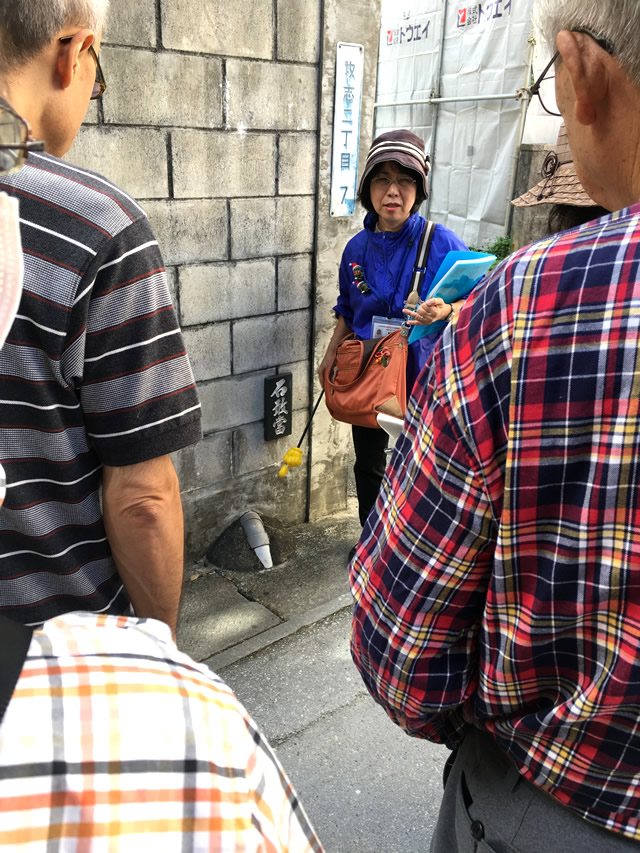
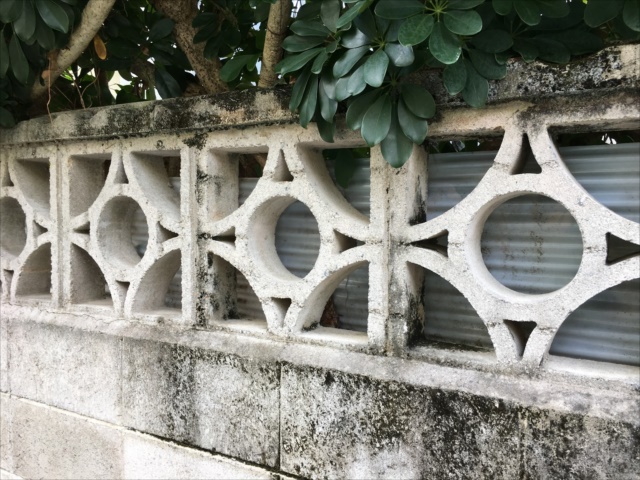

From Makishi Station, walk through the residential area north of Kokusai Street, go straight down the alley in front of Rikkarikka Yu near Naha Central Hotel, and you'll come out onto Kokusai Street next to the former HAPiNAHA.
The first half of the ride ended with a loop around the residential area of Makishi.
I wandered around for a little over an hour, and in the first half, there were 17 mysteries.
We continued for another three minutes or so and stopped at Tenbusu Naha for a restroom break.
Tenbusu Naha is a complex facility where the first floor houses a tourist information center for Naha, and it also includes the Tenbusu Hall where you can watch traditional dances and the Naha City Traditional Crafts Center where you can experience traditional crafts.
1-3. Second Half - Lunch Break from Sakurazaka -
After a short restroom break of about 10 minutes, the second half began.
We proceed along Sakurazaka Nakadori, passing by the Ryukyu glass workshop and the monument to the Great Tug-of-War located in a corner of Tenbusu Naha.


Unlike the residential areas of Makishi, the back alleys of Sakurazaka are lined with old-fashioned snack bars, and the atmosphere of a former "social gathering place" remains strong.
Apparently, it was a playground for "important" people after the war.
"It seems like people over 80 come here to reminisce about the old days," the guide said, but then the name "Pensioners" comes along and it's quite an edgy name for a shop.

It was a story that was somewhat hard to imagine from the quiet daytime scene.
As you approach the Tsuboya area, the atmosphere brightens as fragments of pottery are embedded in the road.

I found the smallest shisa I've ever seen under a guardrail!
Can you see the Shisa statue to the right of the guardrail and pillar? It's so cute.

Local-themed manhole covers can now be seen all over Japan, but apparently, they originated in Okinawa.

As we approached a slightly open, roundabout-like area, we took a snack break at "Tempura Hill." Here, we enjoyed the Okinawan snacks included in the course.
*The participating stores may vary from day to day.

"Okinawan snacks" include Okinawa's specialty, "tempura"! The menu is as follows.

As noted in the disclaimer, we don't always have all the items available!
On this day, they were out of mozuku (!), sata andagi (!), and about two other items.
How could they be missing two of the main ingredients?! It was a complete mess with having to reorder everything.
I had sweet potato, burdock tempura, and fish.

Even though it's made ahead of time, it's not greasy and has a nice chewy texture.
The restaurant was small, so we inevitably ended up sharing a table with other customers from the Naha Machimai group, which was another unusual experience.
People from the nearby construction site and even office workers came in one after another.

In Okinawa, tempura is known for its flavored batter, and it's typically eaten with Worcestershire sauce. I was told that sometimes people even add shichimi (Japanese seven-spice blend) to the Worcestershire sauce.
Adding shichimi (Japanese seven-spice blend) creates a wonderfully refreshing spiciness that wafts through your nose. Give it a try if you get the chance!

Even though it was just a snack break, three pieces of tempura filled me up.
As the conversation continued, mainly led by the guide, a shocking fact was revealed: all 25 mysteries had been solved!
At first, I thought we'd be walking for about two hours, but those two hours flew by.
After enjoying the tempura, we walked to the Tsuboya Pottery Center at the entrance of Yachimun Street to reach our goal (about 5 minutes).

If you head north along the main street in front of the Tsuboya Pottery Center, you will reach Kokusai Street.
The tour concluded with a farewell from the guide, followed by free time for everyone to disperse.
Everyone went their separate ways, some heading towards Kokusai Street, others to cafes on Yachimun Street, and it was a rather uneventful parting (lol).
By the way, if you head in the opposite direction from Kokusai Street from the final goal, you'll soon find another Ufushisa!
I didn't take the main street, but instead went home via Heiwa-dori Shopping Street.
The shopping streets away from Kokusai Street were also interesting, with a strong local feel.


2. Summary
"I was surprised to catch a glimpse of a side of that girl I thought I knew, a side I'd never seen before."
This is what's known as "gap moe," and it's the same when you're traveling.
Discovering a new side of a familiar town can greatly deepen your interest in it.
"Machimai" is full of unexpected charms. You can discover many new sides to your familiar town.
Considering that, perhaps repeat visitors to Okinawa might be more impressed by "Machimai" than first-time visitors.
This time it was the "Machimaai" event in Naha, but as mentioned at the beginning, Machimaai events are held in various locations throughout Okinawa Prefecture.
Many of the courses take about 1-2 hours, making them easy to incorporate into your itinerary, and the participation fees are affordable, starting from ¥1,000.
I have an acquaintance who participated in the "machimaai" (town parade) in both Naha and Miyako Island, and they said that the history and culture are "completely different!"
While enjoying just one course is fun, it would also be enjoyable to participate in and compare courses held in different locations.
"Machimai" is an event that will make you love your beloved Okinawa even more, and I highly recommend you participate in it at least once.
*Answer to Mystery 1: The "upbound" train on the Yui Rail goes to Naha Airport. Upbound and downbound trains are determined based on Tokyo, the capital city.
Related article: Become an Okinawa expert with a Naha town tour! A report from preparation to post-participation impressions.
Okinawa Machimaai (All of Okinawa Prefecture):http://machimai.com/
Naha town tour:http://naha-machima-i.com/
Course details page:http://naha-machima-i.com/wp/?p=6236
Please make your hotel reservation here.
 Rakuten Travel
 Jalan net


Shirokuma Tours offers affordable Okinawa package tours. A wide variety of options are available, including tours to Ishigaki and Miyako Islands.


For local experiences and optional tours such as snorkeling and sightseeing bus tours, choose Tabi Plus One.


For diving in Okinawa, from license acquisition and fun dives to introductory experiences, choose Oceans Dive Tour.
Articles from the same area
 Okinawan Oden! What's different? How is it delicious? ~A report from the University of Tokyo~
 21 Must-See Tourist Spots Around Naha
 Shuri Castle Restoration - Towards Completion in 2026: Current Status in 2024 and the Future - Also featuring sightseeing information around Shuri Castle.
 Access to Shuri Castle | From Yui Rail Station to Shuri Castle! We'll show you the route so you don't get lost.
 [Short-term move to Okinawa] Quitting my job and starting a long-term stay with just a backpack | Naha/Asato edition
 I went to OMO5 Okinawa Naha by Hoshino Resorts! A hotel that lets you explore Naha in a fun and stylish way.
Articles on the same topic
 Go on a sunset kayak tour to watch the sun sink below the horizon of Ishigaki Island.
 [Iriomote Island] Enjoy the World Heritage Site! Complete Guide to Nakama River Mangrove Cruise and Kayaking
 [Closed] Enjoy the luxury of deep-sea water! Refresh your mind and body at Badehaus Kumejima.
 For a travel destination that's guaranteed to be a hit, ask the locals! 10 hand-picked spots highly recommended by Okinawa residents.
 I went to the White Beach Festival! I got to go inside the US military base, which is normally off-limits!
 Uminchi Sea Grape Farm | A place to eat, play, and stay! Their specialty is sea grape soft serve ice cream.