




Ikutouen, located in Tsuboya, Naha, the center of Yachimun (pottery), is a long-established pottery studio in Tsuboya, which boasts a history of approximately 300 years.
Ikutouen produces and sells a wide range of products, from classic Yachimun pottery featuring traditional fish and plant motifs, to designs that blend seamlessly into modern dining tables.
Using Ikutouen tableware in cooking classes (the cooking class is shown here)hereI used it (from) and headed straight to Tsuboya after the cooking class to visit Ikutouen.
After touring the workshop, I participated in a pottery workshop run by Ikutouen.
<Table of Contents>
1. A tour of the Ikutouen pottery workshop.
2. Playing with clay at Ikutouen's pottery experience workshop
3. In conclusion - If you're going to Yachimun Street -
1. A tour of the Ikutouen pottery workshop.
Ikutouen's workshop is located off the main Yachimun Street in Tsuboya, along a narrow road barely wide enough for one small car. It's a two or three-minute walk from the shops along Yachimun Street, and from the outside it looks just like an ordinary house, with two friendly dogs at the entrance. When people approached, they would quietly come closer and wag their tails.
Stepping inside the workshop, you'll find artisans working diligently, surrounded by rows of ceramic pieces in various stages of creation, neatly arranged on rectangular boards.
Three women are painting pottery on tables along the street, while on the opposite side, they are forming Shisa (Okinawan guardian lion-dog statues).


Someone is using a potter's wheel in the back of the room.

Occasionally, craftsmen carrying boards laden with pottery can be seen going back and forth through the workshop.
In the quiet workshop, I was constantly worried that a moment of carelessness might cause a major accident, like snagging my clothes or something.
I realized once again that the plates I used earlier were made by these artisans.

In the space next to the first room, there is an even larger display of pottery.
In front of it is a particularly large, still-in-progress vase adorned with dragon decorations.

This is a work by the sixth-generation potter, Tadashi Takaisu, who is also a certified traditional craftsman. And there he is, standing beside me!

It hasn't even been fired yet, but its size and the intricate details of the decoration already give it an "amazing" feel. Apparently, it's a piece for an upcoming exhibition.
While I was feeling nervous, thinking, "If this gets caught on something, it could be a major accident...", the pottery owner, Mr. Takaesu, stroked the surface of the pot and pointed to the large number of bowls lined up on a board and started talking to me.
"These are the bowls at the Royal restaurant in the airport (the food court on the second floor of Naha Airport). Our part-time staff break so many of them that we make them all year round, haha, just kidding."
Oh, how frank!
I regret that time when I was trying too hard and couldn't react properly to the joke.
The man making the Shisa statues was also very frank.
I watched him working diligently from behind, and he kindly explained the process of making Shisa statues, starting with the work he was currently doing.
First, the basic shape of the Shisa is created by cutting it out using a mold.

These are molded, smooth-looking Shisa statues. You can kind of tell whether their mouths are open or closed.

The craftsman's job is to use bamboo skewers to add eyes, nose, and fur to this featureless Shisa statue.

The Shisa's face has been transformed into a fierce one. The character for "king" on its forehead is from Ikutouen's Shisa♪

The apartment next to the workshop is dedicated to the Shisa-making section.
The "Ufu Shisa" statue near Makishi Station was also made by Ikutouen.

It looks like a perfectly ordinary house, but there are Shisa statues on both the right and the left.
The cupboard is packed full of Okinawan pottery (yachimun).

I was quite surprised and taken aback by how much the craftsman talked to me.
The welcoming atmosphere and the opportunity to witness firsthand the creation of handmade products made the workshop tour, something you don't often get to see, a truly worthwhile experience.
2. Playing with clay at Ikutouen's pottery experience workshop

Just a one or two minute walk from the workshop is Ikutouen's "Pottery Experience Dojo," where you can try your hand at pottery making.
There are various sizes of Shisa statues around the building, and the dojo, with its windows and doors wide open, has a very open and spacious feel.

We immediately went inside the dojo.
The menu is broadly divided into two types: pottery wheel experience and Shisa (Okinawan lion-dog) making. The basic price for each is ¥3,240 per person.
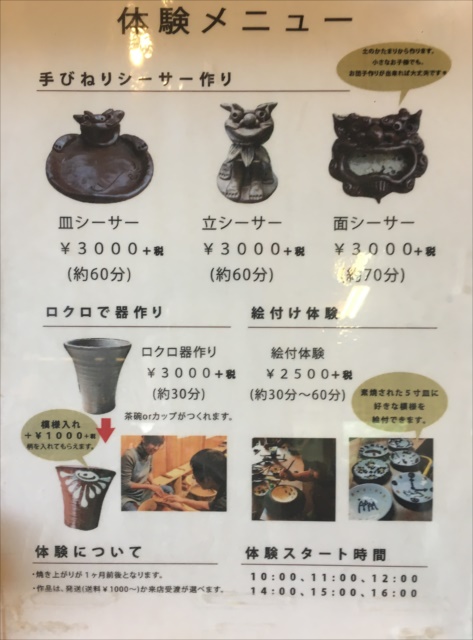
For the pottery wheel experience, you can choose to make either a cup or a bowl, and for an additional 1,080 yen, you can have a craftsman add a pattern to your finished piece. There were no glaze options. All the finished pottery pieces are brown in color. The experience takes about 30 minutes.
There were many pattern samples on display.

For Shisa making, you can choose from three shapes: standing, plate-shaped, or mask-shaped. The Shisa making process takes 60-70 minutes.
Since the finished product will be ready in about a month, I've arranged to have it mailed to me.
Shipping costs vary depending on the destination and weight, but start from ¥1,000. You can also pick up your order once it's ready.
After settling the payment, we immediately began our pottery experience.
This time, I decided to make a cup using a potter's wheel. I put on an apron (which you can borrow) and headed straight to the wheel.
The clay is already set up on the potter's wheel, and you increase the wheel's rotation by pressing the pedal at your feet.
I wet my hands and place them on the swirling soil. The undulating texture feels almost like a living thing.
To make a cup, you first create the height and then make holes to shape it.

Apparently, pottery changes size by about 20% (shrinks) before and after being placed in the kiln.
You need to make it larger to account for a 20% shrinkage.
Making height is relatively easy. Just cup the soil in both hands and gradually narrow it down. Once you've made height, start digging the hole.
The process of drilling holes determines the shape of the pottery.
Stick your finger into the top of the soil, and once you reach a certain depth, widen the hole.
If you apply just a little too much force, the soil will quickly become distorted, and if it's beyond repair, you'll have to start all over again.
Conversely, if you can't apply enough force, you'll never be able to create the desired shape.
It was a journey that required both decisiveness and caution.
Along the way, I used a wooden board to flatten the inside, and somehow managed to complete the shaping process.

Since I finished a little early, I went to tease an acquaintance who was making Shisa statues.

Because the craftsman was teaching us one-on-one, we were able to create a Shisa that looked just like the sample on display.

Everyone did it!
The size and shape are subtly different, and each one has its own unique characteristics, which makes them all the more interesting.
On the other hand, I really admire artisans who can handcraft tableware of the same size and shape.

I'm really looking forward to receiving the artwork.
3. In conclusion - If you're going to Yachimun Street -
After finishing our pottery experience, we went to Ikutouen (a shop) on Yachimun Street. They sell elegant and beautiful tableware and Shisa (Okinawan guardian lion statues).
These were made by the people at the workshop I visited earlier. To be able to create such perfectly symmetrical shapes by hand is true craftsmanship! Thanks to visiting the workshop, I feel like the way I look at Shisa and tableware has changed.
If you're going to Yachimun Street, adding a tour of the pottery workshops will double the fun!
Ikutouen welcomes visitors to tour their workshop, so if you're interested, please inquire in advance by phone or at their shop on Yachimun Street.
| 〇 Ikutouen Main Store Opening hours: 9:30 to 18:30 Holidays: Open all year round Address: 1-22-33 Tsuboya, Naha City, Okinawa Prefecture Phone: 098-866-1635 *For inquiries about workshop tours, please contact Ikutouen Main Store. 〇kamany Opening hours: 10:30 to 18:30 Holidays: Open all year round Address: 1-22-37 Tsuboya, Naha City, Okinawa Prefecture Phone: 098-911-6664 〇guma guwa Opening hours: 10:30 to 18:30 Holidays: Open all year round Address: 1-16-21 Tsuboya, Naha City, Okinawa Prefecture Phone: 098-911-5361 〇Experience Dojo Opening hours: 10:00 to 17:00 Holidays: Open all year round Address: 1-22-33 Tsuboya, Naha City, Okinawa Prefecture Telephone: 098-863-8611 (direct) 098-866-1635 (main) |
Please make your hotel reservation here.
 Rakuten Travel
 Jalan net


Shirokuma Tours offers affordable Okinawa package tours. A wide variety of options are available, including tours to Ishigaki and Miyako Islands.


For local experiences and optional tours such as snorkeling and sightseeing bus tours, choose Tabi Plus One.


For diving in Okinawa, from license acquisition and fun dives to introductory experiences, choose Oceans Dive Tour.
Articles from the same area
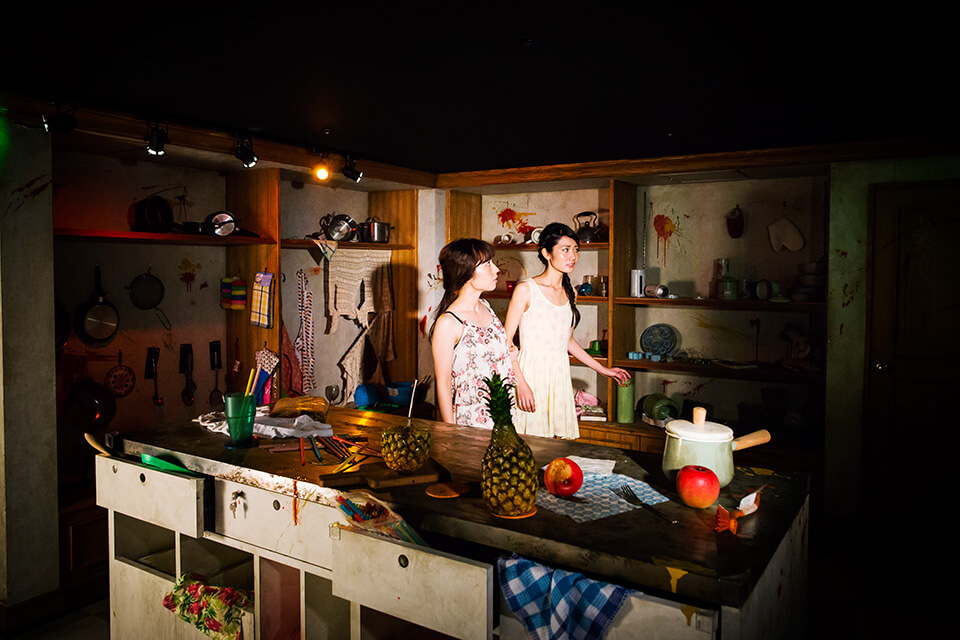 Experience terror and laughter all at once! A report on my experience at the "Okinawa Omoro Haunted House"
 A roundup of Okinawa's fireworks displays | Let's enjoy Okinawa's nightlife too!
 Yamaka Stand | A cute stand located under a banyan tree, one street away from Yachimun Street.
 Want to experience a taste of China while in Okinawa? Take a break at Fuzhou Garden, an oasis in Naha.
 Create your own herbarium at the "yaeee" workshop | Capture your memories of Okinawa in a bottle
 List of prices and sizes for coin lockers and luggage storage facilities around Kokusai Street.
Articles on the same topic
 Every Saturday at 20:00 PM, fireworks are launched at Chatan American Village! Here are some recommended viewing spots!
 Dive in, gaze at the scenery, and find peace! Cape Maeda is full of charm.
 A scenic driving spot! The charm of Nirai Kanai Bridge and surrounding attractions ♪
 Find your love at Okinawa's Heart Rock! There are also Heart Rocks on Kouri Island, Miyako Island, and Ishigaki Island, the islands of love!
 "SHUHARI BIKE WORKS" - A unique bike shop where you can enjoy both rentals and customization | Expand your Chatan travels by bicycle
 Katsuren Castle Sky Lantern Evening Festival 2025 to be held in November to commemorate the 25th anniversary of its World Heritage designation.