




Food is a major part of the enjoyment of travel.
If you're traveling to Okinawa, there's plenty to enjoy, including steak, mangoes, taco rice, sata andagi (Okinawan doughnuts), and other Okinawan culinary delights.
Among them, "Okinawa soba" is definitely a dish you shouldn't miss.
The noodles are chewy, the broth is flavorful, and the dish is topped with pork ribs, pig's feet, and pork belly.
If you're feeling a little hungry, grab a drink; pair it with some juicy rice for a proper dinner.
Whether you want something light and refreshing or something hearty and filling, Okinawan soba has the great thing about it – it can always find something to satisfy your appetite.
As someone who loves Okinawan soba, I decided to not only eat it but also make it myself, so I went to Murasaki Mura in Yomitan Village to experience making Okinawan soba.
<Table of Contents>
1. I tried making Okinawan soba noodles.
1-1. Okinawan soba noodles are made with only two ingredients.
1-2. It's difficult if you're not in sync, so keep stretching the dough!
1-3. Cut, pound, and boil.
1-4. Let's eat!
2. An Okinawan soba noodle making experience I would recommend to everyone.
1. I tried making Okinawan soba noodles.

Located in Yomitan Village, about an hour's drive from Naha Airport, "Experience Kingdom Murasaki Mura" (hereinafter referred to as Murasaki Mura) is a tourist facility characterized by its atmospheric grounds and the variety of "experiences" that can be enjoyed, and was once the site of filming for an NHK historical drama.

This time, I made a reservation in advance for an Okinawan soba noodle making experience.
At the entrance to Murasaki Mura, you will receive a registration form after paying the entrance fee and the fee for the Okinawa soba noodle making experience.
Check the designated store on the park map, and hand in your registration form when you arrive at the store.
1-1. Okinawan soba noodles are made with only two ingredients.

This time, our Okinawan soba noodle making experience took place at "Ajimaya," located almost in the center of Murasaki Mura.
In addition to offering light meals such as Okinawa soba and shaved ice at the food court-style shops in Murasaki Mura, you can also experience making Okinawa soba and sata andagi (Okinawan doughnuts).
Hand your registration form to the staff and then proceed to the experience space located next to the kitchen.
Please leave your bag on the shelf at the edge of the experience space. Bring an apron if possible.

I accidentally forgot my apron and borrowed one, but there aren't even 10 available, so you might not want to rely on them on weekends or during peak season.
This time, the main focus is on making the noodles, and the broth and pork ribs (soki) toppings will be provided by the restaurant.
The ingredients for Okinawa soba (noodles) are just two things: strong flour and salt water.
Some people add lye water, eggs, or baking soda to it.

The ingredients were all measured and prepared in advance, so the actual quantities are a mystery.
According to my research online, if you're using 200g of strong flour, you should dissolve about 1 teaspoon of salt in 100ml of water to make saltwater.
The process is very simple: mix, knead, cut, and then boil.
First, put the bread flour and salt water into a bowl and stir until the water is evenly distributed throughout the flour.

At first, it will stick to your hands, but once it becomes uniform, you'll be able to neatly shape it into a ball.
Once the dough has come together somewhat, spread some flour on the work surface and knead it using the base of your thumb on your palm.
Pressing the dough against the board will cause it to absorb the flour and become dry, so instead of pressing it, knead it with the fingers and palms of both hands.
To determine if you're pressing too hard, check if the dough is sticking to the work surface.

Is this right? Is this okay?
This was quite difficult and I struggled a lot.
But as you continue kneading, the dough gets softer and softer, and even smoother.
After kneading for about 15 minutes, a staff member checked it and thankfully it passed!
Let the dough rest for about 10 minutes to give it elasticity.
1-2. It's difficult if you're not in sync, so keep stretching the dough!

While the dough was resting, I took a stroll around Murasaki Mura Park. As it was a filming location for a historical drama series, it felt just like a small village.

The Ryukyu Lantern Festival was being held at the time, and it was very lively with colorful lanterns.
Return after 10 minutes and this time stretch the dough.
Place the dough on a bed of flour and flatten it with your palms.

Once it's about 1 centimeter thick, use a rolling pin to make it even thinner.
The process of rolling out the dough is done in pairs.
Initially, one person holds one end of the dough while the other rolls out the dough by pulling the rolling pin towards them.
Rotate the work surface by 90 degrees and continue the same process.
Once the dough is about 3mm thick, one person takes on the role of applying pressure to the dough with a rolling pin, using their whole body and soul.
The other person holds down the edge of the dough while pushing and moving the rolling pin.

I had a really hard time getting this to work (lol).
I'm supposed to do the tasks in order, but for some reason I always lose track of what I'm supposed to do.
I managed to stretch it out to about the thickness of a slightly thick crepe, and it was done.
1-3. Cut, pound, and boil.

When you wrap the thinned dough around a rolling pin and fold it, then pull out the rolling pin, the dough will take on a shape similar to a rolled omelet.
After roughly cleaning up the dust remaining on the work board, it's finally time to start cutting.
Cut about 1 cm wide by pressing down from above, applying your body weight, rather than moving the knife back and forth.
It looks more like kishimen noodles than Okinawa soba!
When I asked for the reason, they said that cutting it into thin strips increases the number of cut surfaces, causing it to absorb flour from the cut surfaces and become dry and crumbly.
After cutting, lightly loosen the noodles, then slam each noodle against the work board to remove any excess flour.
The process involves repeatedly pounding the noodles, wiping the flour off the board with your hands, and moving it to the side.
Until a moment ago, it had a shape similar to kishimen noodles, but after being pounded, it became pliable and resembled Okinawan soba.
Next, dump the noodles into a large pot of boiling water.
The noodles will float to the surface in about a minute, so use a colander and bowl to mix them together.

If you're too slow, the noodles will stick together, so don't shake them too much; just gently drain the water and quickly put them into a bowl.

A staff member carries the bowl of noodles to the kitchen and puts the final touches on it.

1-4. Let's eat!

The finished Okinawan soba is pure white because the only ingredients are strong flour and salt water.
The broth has a wonderful bonito aroma, and the pork is soki.
I lifted the noodles with my chopsticks and took a bite.
!
I can't believe I made these chewy noodles myself!
It's lighter than what I usually eat, and the delicious broth makes it easy to eat a lot.
Apparently, oil has traditionally been used to preserve the noodles in typical Okinawan soba.
But since you eat it right after making it, you don't need oil. Plus, there's no distinctive smell like dried noodles, and fresh noodles are just the best! The difference is quite amazing.
The pork ribs used as a topping were also tender, and I easily finished the entire bowl.
From making the Okinawan soba to finishing the meal, it took about 90 minutes, and thinking back, I was laughing the whole time, so I left the restaurant feeling quite exhausted (lol).
2. An Okinawan soba noodle making experience I would recommend to everyone.

This was my first time trying Okinawan soba noodle making, and it was incredibly fun and delicious! I highly recommend it.
This is especially enjoyable for small groups, such as girls traveling together or couples. The lack of coordination while stretching the dough is quite hilarious!
With nearby attractions such as Cape Zanpa and Cape Maeda (Blue Cave), why not combine sightseeing and lunch with a soba noodle making experience at Murasaki Mura?
Murasakimura Experience Kingdom
Address: 1020-1 Takashibo, Yomitan Village, Nakagami District, Okinawa Prefecture
Phone: 098-958-1111
Opening hours: 9:00 AM - 18:00 PM (Last entry 17:30 PM, excluding special opening hours)
HP:http://murasakimura.com/
Murasaki Mura Admission Fees: Elementary School Students ¥400, Junior and Senior High School Students ¥500, University Students and above ¥600
☆Discount coupons are available for purchase on the Murasaki Mura website♪
Okinawan soba noodle making experience (approximately 90 minutes)
For groups of 3 or fewer: ¥2,160 per person
For groups of 4 or more: ¥1,950 per person
*Participation is available for elementary school students and older, only with parental supervision.
*Please bring your own apron.
Please make your hotel reservation here.
 Rakuten Travel
 Jalan net


Shirokuma Tours offers affordable Okinawa package tours. A wide variety of options are available, including tours to Ishigaki and Miyako Islands.


For local experiences and optional tours such as snorkeling and sightseeing bus tours, choose Tabi Plus One.


For diving in Okinawa, from license acquisition and fun dives to introductory experiences, choose Oceans Dive Tour.
Articles from the same area
 Take a more casual island trip! A recommended driving tour of Ikei Island.
 Matsuda Shoten | A selection of goods that's a little different from supermarkets. Find Okinawan products and food in the modern town of Yagwa.
 Workation in Okinawa's Chatan! 5 Recommended Hotels
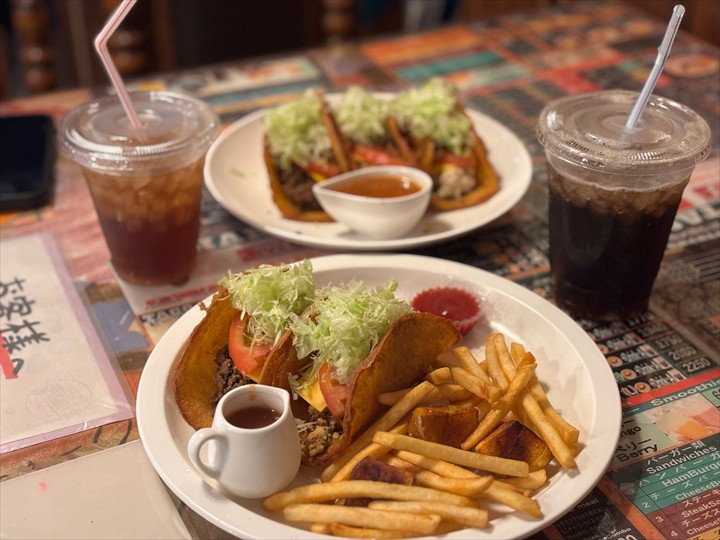 Founded in 1956, "Charlie Tacos Main Store" is "Okinawa's first taco shop."
 I went to "Experience Kingdom Murasaki Mura"! Here's a report of my various experiences.
 How to get to BEACH51 (Zane Beach) | "Rock Window" is a popular photo spot
Articles on the same topic
 Want to enjoy hot springs in Okinawa too? Here are 5 recommended spots!
 I went to Vita Smoothies in Naha!
 Warm your heart and body! 5 Okinawan warm food options available for takeout.
 Awamori (Okinawan distilled spirit) with island chili peppers!? A unique flavor you can only find here: "Uruma Gelato"
 Diving in Okinawa's Blue Cave! [Introductory Diving & Fun Diving]
 Miyagi Coast | Chatan Town's premier snorkeling spot, surrounded by stylish restaurants!