

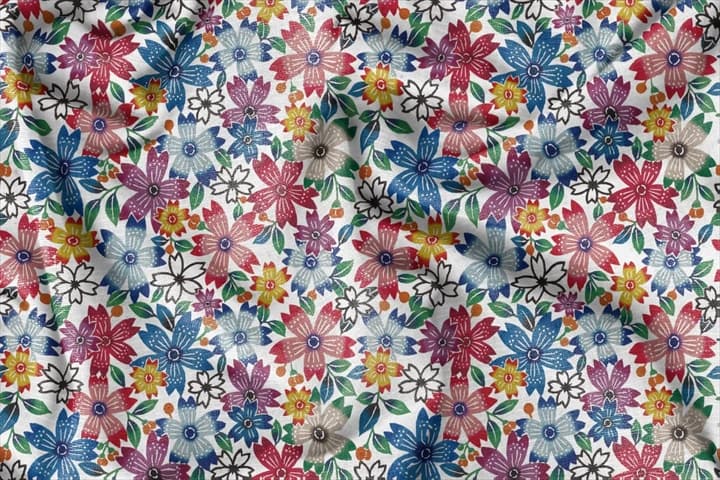
BLANCJUJU is a company based in Chatan Town that creates "Bingata," a traditional Okinawan craft.
BLANCJUJU's bright and light bingata designs are widely loved and used in a variety of products, including kimonos, original accessories, uniforms for resort hotels and campaign models in Okinawa Prefecture, and more recently, designs for airline original products. You may have even seen them without realizing it.
Founded with the idea of "bringing Bingata (Okinawan dyeing technique) into everyday life," BLANCJUJU has been recognized as a "Chatan Brand," a representative product of Chatan.
This time, we interviewed Ms. Yoshimizu, the owner and designer of BLANCJUJU, about the process of making Bingata dyed textiles.
・Bringing Bingata into everyday life
・The starting point of the current style: Bingata dyeing beyond just fabric.
・A New Challenge - Casual Kimono -
Show all table of contents
Bringing Bingata into everyday life
Yoshimizu-san was so captivated by Bingata (Okinawan dyeing technique) that she moved to Okinawa. After working for 12 years at a Bingata workshop in Okinawa Prefecture, she decided that now was the time to start something new, given her physical limitations, and became independent in 2015, establishing BLANCJUJU.
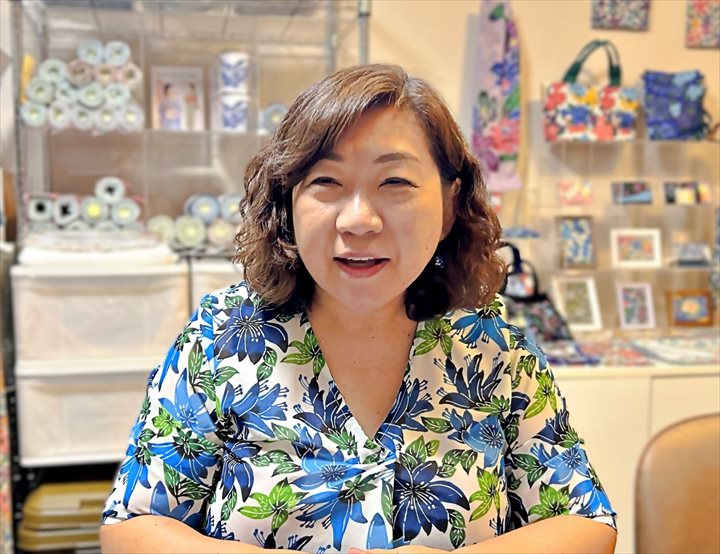 "Even if you don't know anything about Bingata, I want people to pick up her Bingata because they simply think it's cute," says Yoshimizu, whose Bingata pieces have a very lovely impression due to their bright colors.
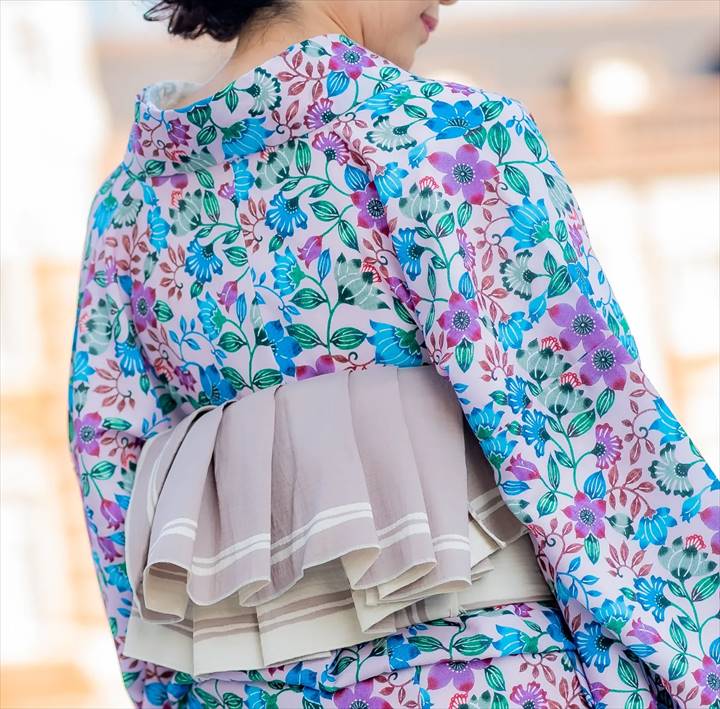 Traditional Bingata dyeing uses rich colors to depict birds and flowers that evoke the natural landscape of Okinawa. It embodies the very essence of Ryukyu culture, combining the splendor of Chinese culture with the grace of Japanese aesthetics.
BLANCJUJU also uses motifs such as Okinawan flowers and birds, but Yoshimizu also incorporates flowers and batik patterns that she finds appealing.
The use of color is a key point where an artist's individuality shines through. Each artist apparently has about 10 base colors, and their sensibilities naturally come through in their bingata dyeing.
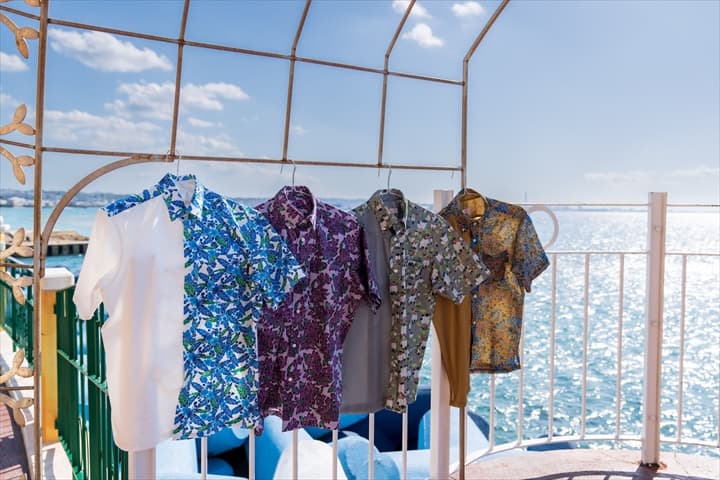 Men's apparel items are also brightly colored. Kariyushi shirts are likely to attract attention when visiting Okinawa on business or attending weddings.
The starting point of the current style: Bingata dyeing beyond just fabric.
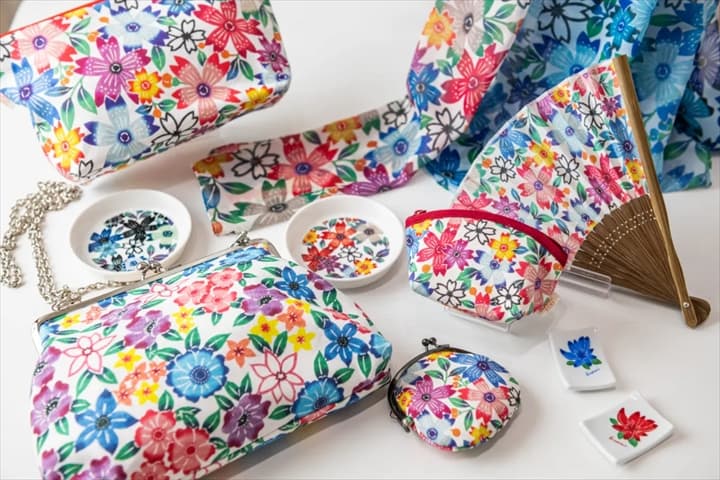 BLANCJUJU's bingata is characterized by original patterns created by Yoshimizu's sensibilities and the process of digitizing designs based on hand-dyed fabrics.
The idea to digitize the work originated from the desire to combine Bingata dyeing with glass.
Furthermore, the fact that Bingata, which is produced through meticulous and immense manual labor, is inevitably expensive was a major obstacle for Ms. Yoshimizu, who wants people to use Bingata on a daily basis, but digitization proved to be the solution.
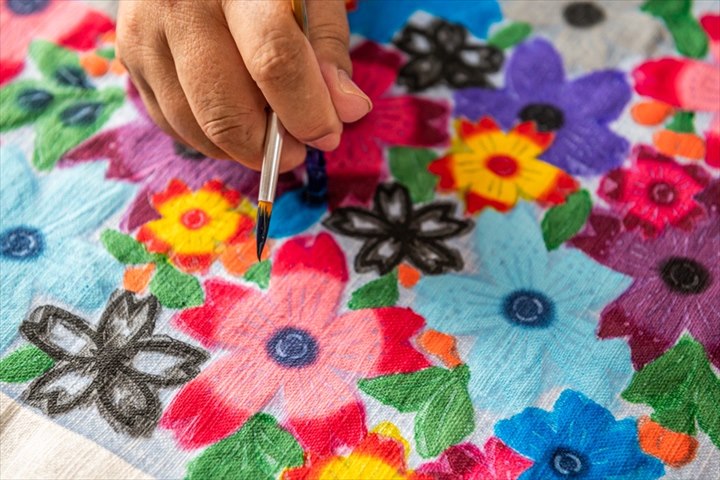 "In Bingata dyeing, you carve a stencil, use that stencil to transfer the design onto the fabric, and then dye it. Next, you apply a paste to the dyed areas to prevent the color from transferring, a process called 'paste-proofing,' before applying the background color. After that, there are processes such as fixing the dye and removing the paste, so Bingata dyeing is an extremely intricate and time-consuming process that involves repeated steps."
Making large pieces of fabric is incredibly difficult. For example, making a kimono requires about 13.5 meters of fabric, and for the design, you need around 75 different patterns. (Each pattern is roughly slightly larger than A4 size.)
For intricate designs, the adhesive application process can take almost an hour per pattern.
Back then, it was a very humid time of year, and I spent about a week working on the paste-covering process, but mold grew on the part I had started working on first, and it all went to waste."
By digitizing the designs, we were able to create kimonos that made extensive use of bingata (Okinawan dyeing technique), and we were also able to expand the use of bingata beyond just fabric.
The driving force behind BLANCJUJU's current style is the desire to use and share the Bingata dyeing technique, which I love, more in everyday life.
A New Challenge - Casual Kimono -
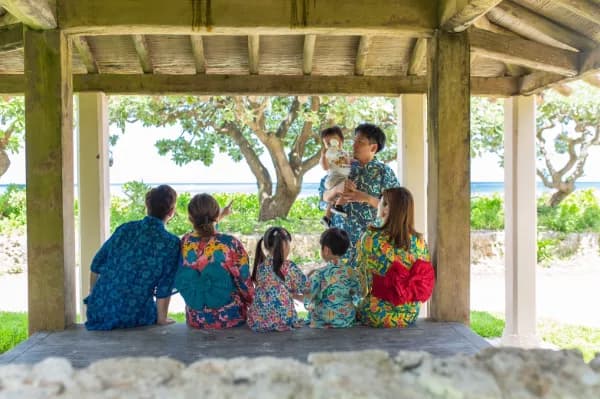 What BLANCJUJU is currently focusing on most is "casual kimono."
We're venturing into a new field, aiming to make Bingata kimonos more affordable and encourage people to wear them on a daily basis.
BLANCJUJU's kimonos and yukatas are available for purchase on their website, and can also be viewed at their office and gallery in Chatan Town (advance notice required).
Additionally, at the "Utuimuchi Project" near Mihama American Village, you can experience wearing a BLANCJUJU bingata yukata.
Some hotel gift shops and other places carry BLANCJUJU's products, mainly small items, so try looking for BLANCJUJU's bingata designs there.
- Address
- Sky Flower Kuwae 1F, 588-15 Kuwae, Chatan-cho, Nakagami-gun, Okinawa Prefecture
- Business hours
- 11:00-19:00 (Closed on Tuesdays)
- Remarks
- Please contact us in advance if you wish to visit the gallery.
- Address
- 15-15 Mihama, Chatan Town, Nakagami County, Okinawa Prefecture
- TEL
- 098-880-6661
- Business hours
- 10: 00-17: 00
- Remarks
- Experience menus require advance reservations.
Articles from the same area
 "Mainichi Shokudo," which opened in Yomitan Village, is an Okinawan soba restaurant that has become a favorite among locals.
 Kadena Roadside Station | A spot where you can enjoy views of the US military base from the observation deck and a wide variety of gourmet food.
 Workation in Okinawa's Chatan! 5 Recommended Hotels
 Matsuda Shoten | A selection of goods that's a little different from supermarkets. Find Okinawan products and food in the modern town of Yagwa.
 Ice cream in the night breeze | A popular shop with long lines at night?!
 Retro and charming Minatogawa foreign residences | Recommended lunch spots, cafes, and shops
Articles on the same topic
 Falling in love with Okinawan chocolate ♡ A single piece of blissful chocolate from Jacaranda Blue
 A complete guide to enjoying snorkeling in Miyako Island 10 times more!
 Michi-no-Eki Ogimi Yanbaru Forest Visitor Center | Specialties: Fruit & Soba! A roadside station where you can also enjoy activities.
 The sweet scent of fruit wafts from the vast grounds! Take a stroll through the forest on a cart at Maipari Miyako Island Tropical Fruit Orchard♪
 Sauna x Light, Infinity Pool x Light Show. Seven x Seven Ishigaki presents "Lightscape Ishigaki" for a limited time this winter.
 T Galleria Okinawa by DFS | Japan's only store where you can enjoy duty-free shopping even when traveling domestically!