


In Okinawa, flowers bloom continuously throughout the year. Many visitors are surprised by the different flowering seasons compared to mainland Japan, and by the vibrant colors even in winter. The flowers, which change their appearance with each passing season, are one of the hidden pleasures of visiting Okinawa. This time, we will introduce the flowers of Okinawa that you can encounter in each season.
【spring】
・Deigo (Okinawa Prefecture's prefectural flower)
・ブーゲンビレア
・ヒスイカズラ
・Trumpet lily
【summer】
・Getto
・サガリバナ
・plumeria
【autumn】
・オオゴチョウ
・トックリキワタ
【winter】
・Cosmos
・Kanhizakura
・電照菊
Show all table of contents
Spring (March to May)
Deigo (Okinawa Prefecture's prefectural flower)
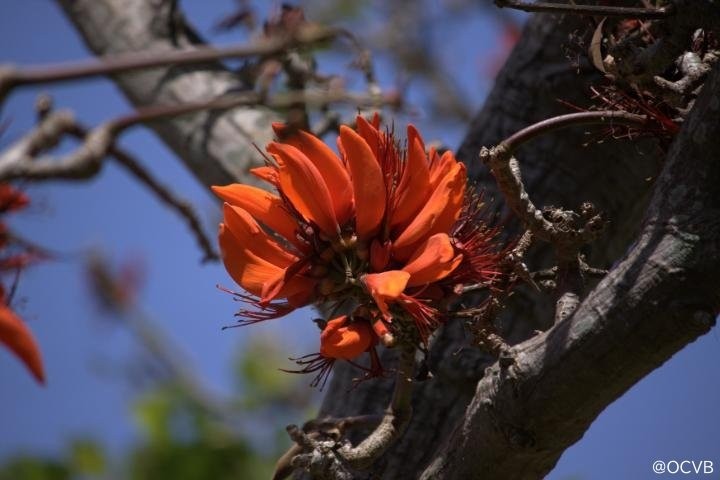
The coral tree (Erythrina variegata) is designated as the prefectural flower of Okinawa Prefecture and is characterized by its fiery red flowers that bloom at the tips of its branches. It usually begins to bloom around March and reaches its peak in April and May, making it a beloved flower that signals the arrival of early summer. The bright red flowers stand out against the blue sky, and their vibrant appearance further enhances the beauty of the southern landscape. You can admire them in various locations throughout the prefecture, such as Manko Park in Naha City and around Motobu Town, so be sure to enjoy the seasonal colors while driving or strolling around.
ブーゲンビレア

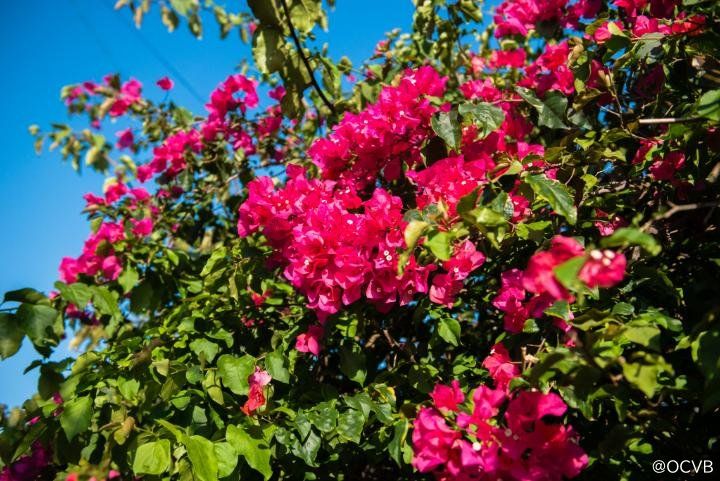
Bougainvillea, often seen in towns and residential areas, greatly enhances the tropical atmosphere. While its main blooming season is from April to October, Okinawa's warm climate allows it to be enjoyed almost all year round. Its vibrant pink, purple, and white flowers are striking, and it can be seen blooming in arches at Southeast Botanical Gardens and Bios Hill. It's one of Okinawa's most distinctive flowers that you can easily encounter while traveling.
ヒスイカズラ

The jade vine is a rare climbing plant native to the Philippines, characterized by its uniquely shaped flowers that are emerald green or blue-green in color. Its hues resemble the gemstone jade, and its beauty is so captivating that it's truly mesmerizing. The flowers bloom in clusters that hang down, creating a cascading appearance that resembles living jewelry. In Okinawa, it is in full bloom from March to May and can be seen at places like the Southeast Botanical Gardens, Bios Hill, and DINO Dinosaur Park Yanbaru Subtropical Forest.
Trumpet lily
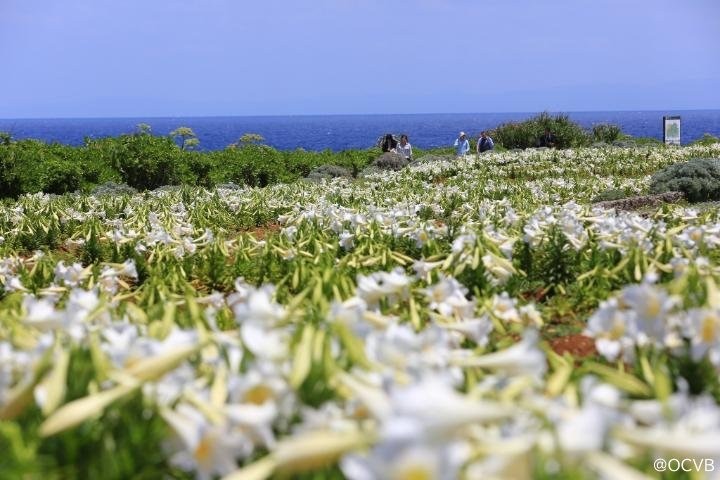
The trumpet lily, with its beautiful white and dignified appearance, is one of the representative flowers of early summer in Okinawa. It gets its name from the fact that its long, tubular flowers resemble a gun. The main blooming season is from April to June. It can be found in abundance in northern Okinawa Island and on the outlying islands, but Ie Island is particularly famous. At the "Ie Island Lily Festival" held every year, approximately 1 million trumpet lilies spread out, creating a breathtaking carpet of white flowers.
Summer:
Getto
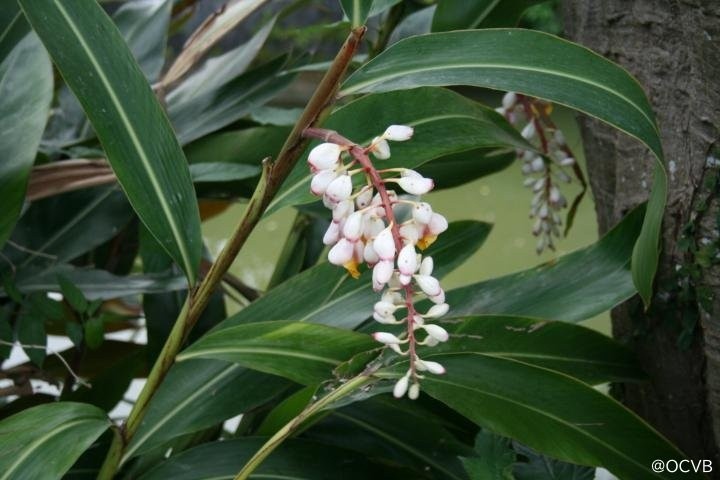
Alpinia zerumbet is characterized by its large, glossy leaves and delicate white flowers tinged with pale pink. It emits a refreshing fragrance and is popular for its insect-repelling and perfumery properties. The leaves are also used to wrap mochi (oni mochi), a traditional Okinawan food eaten during ceremonies, and steaming them releases a subtle aroma. The plants are typically in bloom from April to June, and you can enjoy their clusters at Neo Park Okinawa in Nago City. Since it's a plant you often see in urban areas, be sure to gently touch it and enjoy its fragrance when you come across it.
サガリバナ

Barringtonia racemosa is a tropical flower that blooms at night with delicate white or pale pink blossoms, emitting a sweet and gentle fragrance. The best time to see them is from June to August, when they bloom after sunset. Their charm lies in their ephemeral beauty, as they only bloom for one night before wilting by morning. They often grow near water, and can be seen along rivers on Iriomote Island and around Hiji Falls in northern Okinawa Island. The sight of the fallen petals spreading across the water's surface in the early morning is fantastically beautiful. If you search for "Barringtonia racemosa" on Google Maps, viewing spots will be displayed.
plumeria

Plumeria is a representative flower of the tropics, characterized by its thick, rounded petals and sweet, elegant fragrance. It comes in a variety of colors, including white, yellow, and pink, and typically blooms from around May to October. In Okinawa Prefecture, it can be seen in resort hotel gardens and parks, and also around Shuri Castle Park in Naha City. Its lovely appearance against the blue sky further enhances the tropical atmosphere.
Fall:
オオゴチョウ
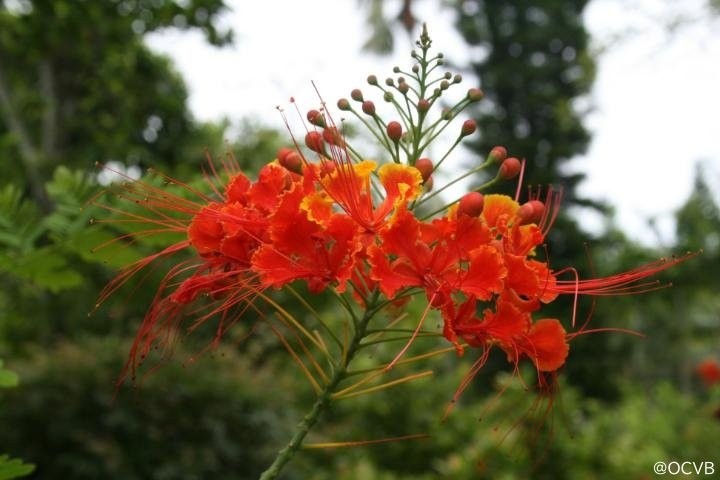
The Caesalpinia sieboldii is a tropical flowering tree that produces vibrant flowers in a mix of red, orange, and yellow. It gets its name from the fact that its long, slender stamens resemble butterfly wings. It mainly blooms from May to October and is a familiar sight as a street tree, in parks, and in gardens. In Urasoe City, it is designated as the city's official flowering tree and is widely loved by the residents. Its cute appearance might make you want to touch it, but be careful as it has small thorns.
トックリキワタ

The silk floss tree (Ceiba speciosa) is a flowering tree that beautifully adorns the autumn landscape of Okinawa. It mainly blooms from October to December, with pale pink flowers blooming at the tips of branches after the leaves have fallen. Its distinctive shape, resembling a sake bottle with a bulging center, is also a characteristic feature, and it is a popular street tree. The soft colors of the flowers blooming against the blue sky create a tropical scene, and the cottony seeds spreading at its base evoke a sense of the changing seasons. It is one of the flowers that symbolize autumn in Okinawa.
Winter:
Cosmos

Cosmos flowers, with their wide range of colors including pink, white, and deep crimson, are charming and have a simple, unpretentious appearance. While they are at their best in Honshu from September to October, in warmer Okinawa they generally bloom from January to March. Every year around this time, the "Yomitan Cosmos Festival" is held in Yomitan Village, where approximately one million colorful cosmos flowers bloom. The sight of the vast fields covered in flowers is breathtaking, and the area is bustling with visitors enjoying photography and strolling around. You can also enjoy viewing cosmos in fields in Nishihara Town and Nago City.
Kanhizakura

The Kanhizakura cherry blossoms, which bloom in Okinawa from mid-January to early February, are known as the earliest blooming cherry blossoms in Japan. Their deep pink flowers are bell-shaped and hang downwards, and they are characterized by falling as whole flowers rather than just petals. Their vibrant and powerful beauty sets them apart from the Somei Yoshino cherry blossoms popular on the main island of Japan. Cherry blossom festivals are held at various locations throughout the prefecture, including Nago Central Park, Yaedake Mountain, and Nakijin Castle Ruins, coinciding with the blooming season, attracting many locals and tourists every year.
電照菊

Chrysanthemums grown under artificial light are cultivated by illuminating them with light bulbs at night to control their flowering period. The rows of bulbs across the fields emit a soft glow, creating a fantastical landscape. Due to its beauty, it is affectionately known as "Kikumination" in Okinawa and is a popular spot for drives and dates. The best time to see them is from November to January. You can enjoy them in areas where chrysanthemum cultivation is thriving, such as Itoman City, Yaese Town, Yomitan Village, and Kanekadan in Uruma City, in central and southern Okinawa Island.
Articles from the same area
 Getting married in Okinawa ♡ A complete guide to destination weddings! Costs, chapels, photo weddings, etc.
 March to May is the best time to see them! Let's go see the stunning blue landscape of "Jade Vine" that spreads across Okinawa.
 Want to have a beach party in Okinawa? Tips for enjoying a beach BBQ on your Okinawa trip.
 A true classic! We tried 24 different kinds of Chinsuko, a popular Okinawan souvenir!
 Become an Okinawa expert with these 6 table condiments you'll want to use the local way!
 We tried and compared 8 different types of "Jushi no Moto," a staple of Okinawan home cooking!
Articles on the same topic
 Tokei Beach Basic Information | Okinawa's Natural Beaches Where You Can Experience Simple Natural Beauty Vol. 2
 Enjoy a live sanshin (Okinawan stringed instrument) performance at "Goya," a pub in Miyako Island!
 The only place in the world! The deep charm of the "Yonehara Yaeyama Palm Grove"
 Three must-see beaches on Kouri Island
 [2026 Edition] Okinawa's Charms Galore! We'll Tell You About the Highlights and How to Enjoy Ocean Expo Park!
 If you're planning a girls' trip to Okinawa, check out our top 20 must-see spots and hotels!