



Makishi Public Market is located along "Market Central Street," which is adjacent to Kokusai Street.
For over 60 years since its opening, it has been loved by many as "Naha's kitchen."
In recent years, it has become a popular tourist destination, attracting visitors who appreciate the opportunity to experience Okinawa's food culture.
This time, in order to explore its appeal, I actually went there and will report on what I saw.
From recommended dishes to lunch, I thoroughly enjoyed myself!
*The prices mentioned in this article are based on information from September 2016 and may have changed since then.
<Contents>
1. What is Makishi Public Market?
2. Let's go to Makishi Public Market! ~From Kokusai Street~
3. Recommended Products Report from the Market!
4. Lunch and dessert time at Makishi Public Market!
5. Author's thoughts
1. What is Makishi Public Market?

Makishi Public Market was established in 1951, shortly after the end of World War II.
Most of the shops in the market have a long history, having been in business for 50 to 60 years.

Examples of shops:
Seafood caught in the waters around Okinawa, locally grown vegetables and fruits, locally produced pork and beef, island tofu, fish cakes, pickles, seasonings, sweets, etc...
With so many different shops gathered in one place, it's fun just to look around!
I think I'm starting to understand why it's called "Naha's kitchen."
2. Let's go to Makishi Public Market! ~From Kokusai Street~
I actually walked from Kokusai Street to Makishi Public Market!

First, look for the "Ichiba Hon-dori" sign, which is marked in yellow and blue, and enter that street.
(If anything, I feel like Kumamon is more eye-catching...)
▼ Kontakgawaigawai

Just to the left upon entering the market, you'll find a shop selling sweets made with Okinawan fruits.

The sign with its tropical colors is adorable.

In addition to cut fruit, we also sell processed products such as juices.
On the day of the interview, the weather was sunny and the temperature was rising, which may have contributed to the large number of visitors.
Sightseeing with a pineapple stick or other fruit in hand is a very Okinawan experience!
▼ Kontakgawaigawai

Other options include Blue Seal Ice Cream, which originated in Okinawa, and
(My favorites are the salt chinsuko ice cream and the purple sweet potato soft serve ice cream.)
▼ Kontakgawaigawai

A wide variety of nostalgic Okinawan snacks, such as Kunpen (Konpen), are available. Each item is reasonably priced, so you might find yourself buying more than you intended.
▼ Kontakgawaigawai

"It's effective for hangovers!" says the "Legend of Heavy Drinkers," a hot topic among the Okinawa Lab editorial staff.
*According to the Okinawa Lab editorial team, who are regular users, it's truly incredibly effective.
▼ Kontakgawaigawai

A colorful frozen drink inspired by the colors of a rainbow. The vibrant colors are eye-catching!
▼ Kontakgawaigawai
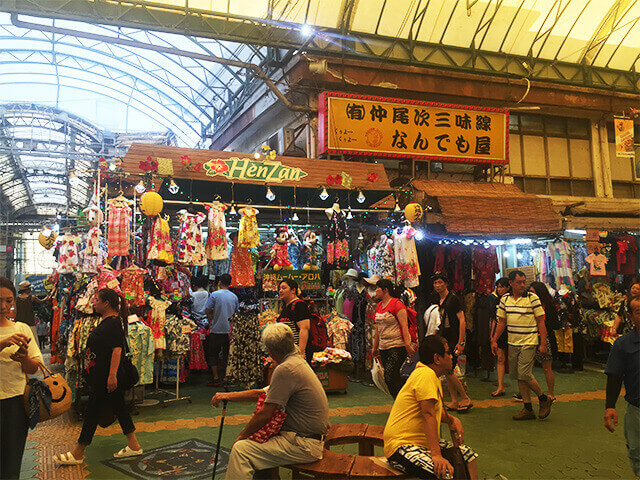
After walking for a while (2-3 minutes), I found a general store that sold various kinds of clothing, including Kariyushi shirts.
It really stands out even on the street. (The relaxed look of the hanging Korilakkuma is simply irresistible.)
▼ Kontakgawaigawai

A leisurely stroll down the main street of the market takes about 10 minutes.
We can now see our destination, Makishi Public Market, on our right!
▼ Kontakgawaigawai

Looking up, I could see a sign.
Turn left and you'll see a door; enter through there!
3. Recommended Products Report from the Market!

Now, I'll introduce some items that I personally recommend!
(Apparently, the decorations on the pig in the photo change daily.)
・Island scallions
I think the vast majority of people associate pickled shallots with a strong smell.
However, the pickled Okinawan shallots don't have a strong smell, and their crisp texture is delicious!
*This is purely my personal opinion.

This time, I had the opportunity to sample this pickled kelp.
The rich flavor of the kelp and the crisp texture of the Okinawan shallots are a perfect match, and I could eat so many of them!
This is a dish I would especially recommend to those who love pickles.
Fish from Okinawa Prefecture
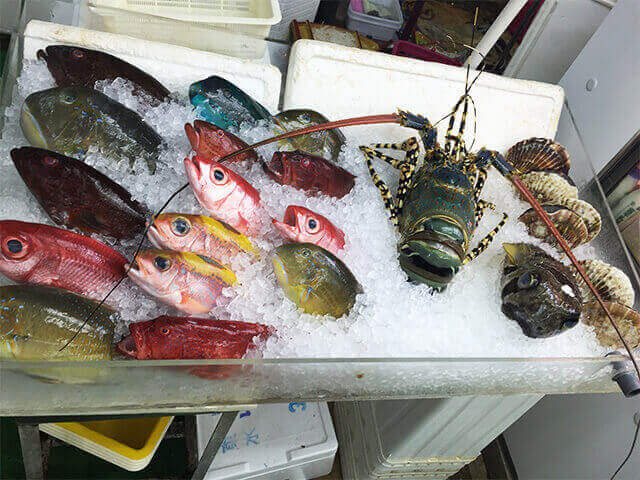
The display features a colorful array of fish and slipper lobsters in red, yellow, and blue, typical of the tropical climate of Okinawa.
In Okinawa, the most popular fish are said to be the blue parrotfish (Irabucha) and the red snapper (Mimija).

Both have unusual appearances, but the taste is quite good.
Later, I had irabucha and mimija as sushi, and both were delicious with no unpleasant taste!

This is a pufferfish!
This is quite different from the familiar image of a puffed-up porcupinefish.
Incidentally, in Okinawa, they call it "abasa" (meaning a talkative woman).
The main ways to eat it are as an ingredient in soup, in a hot pot, or deep-fried.
Among them, "Abasa soup" is said to be perfect for hangovers.
"I've had a little too much awamori and Orion beer..." In times like these, this is the perfect solution!

Traditional Chinese characters were seen scattered throughout the market.
• Meat products and other processed foods from Okinawa Prefecture

You've probably all seen it at least once – the incredibly impactful Chiraga!
If you cut it and eat it, it becomes the familiar pig's ear.
Apparently, if you slice it and then warm it up a little before eating, the pork's flavor comes out and it tastes delicious.
For those who aren't keen on pig's cheek, we recommend ham and sausages made with Agu pork.
The meat's flavor is concentrated and it's incredibly delicious!

Speaking of Okinawan specialties, there's "pork luncheon meat."
Currently, the two most well-known brands are 'SPAM' and 'TULIP'.
This time, I've summarized the simple differences between the two.
*SPAM...Originating in the United States, it is made from ham. It is characterized by its salty taste and has a slightly distinctive flavor. It pairs well with dishes that have a mild flavor, such as pork rice balls.
*TULIP...Originating from Denmark, it is made from bacon. It has a mild flavor with no strong taste. It is best used as part of an ingredient in dishes such as Goya Champuru.
・Bonus episode!

The one I personally found interesting was "The Snake"!
Below that, you'll find a selection of unique souvenirs, such as turmeric tea and Ryukyu bombs.
If you don't have the courage to buy it, at least take a picture to use as a conversation starter!
4. Lunch and dessert time at Makishi Public Market!

After getting a glimpse of Okinawan food culture on the first floor, we moved to the dining area on the second floor and actually had lunch.
It's also a great option for lunch when you're sightseeing in Okinawa.
・Machigwa Shokudo [Dotonbori]
 This time, I ate at the Machigwa Shokudo "Dotonbori".

Menu item ①.
In addition to the classic Okinawan soba noodles, this restaurant offers a variety of Okinawan regional dishes, including seafood and rice bowls.
There's also Chinese food, too.

Menu item #2.
This is where the set meal menu is listed.
They all look so appealing, I can't decide what to eat.
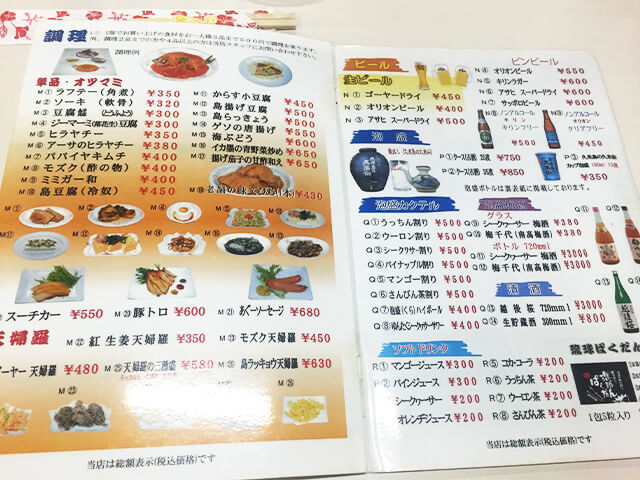
Menu item #3.
It features alcoholic beverages and snacks.
Personally, I was intrigued by the crow tofu...
In the end, I asked the staff for their recommendation and placed my order. (I couldn't decide on my own...)

While waiting for my food, I took some photos of the restaurant's interior.
This photo shows a beer dispenser and awamori (Okinawan distilled spirit).
Many people were drinking beer from lunchtime onwards.

On the table are toppings such as pickled ginger, Koregusu (Okinawan chili sauce), and soy sauce.
The toothpicks and disposable chopsticks also have a retro feel.

While I was waiting, my order of "Yushi Tofu Set Meal" arrived. (950 yen, tax included)
The meal is incredibly filling, featuring yushi tofu served in a large bowl, along with rice, mozuku seaweed, and deep-fried gurugun fish!

The chewy texture of the mozuku seaweed was irresistible! I finished it in no time.

Next up is deep-fried gurugun. It looks a bit unusual, but the taste is outstanding!
Deep-fried white fish, with its mild flavor, is surprisingly easy to eat.
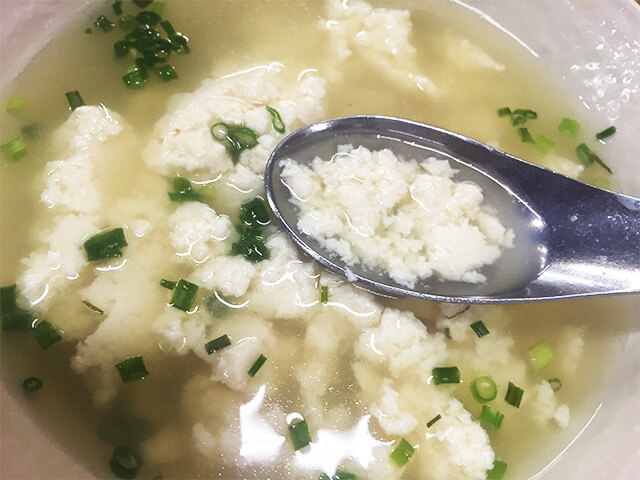
This is the main dish, yushi tofu. "Yushi tofu" refers to soft, unset tofu.
The texture is so tender it crumbles easily, and the light soup makes it very enjoyable!
The tofu also has a stronger soybean flavor than regular tofu.
The portion was large, but it was very easy to eat, so I finished it all. It was delicious.
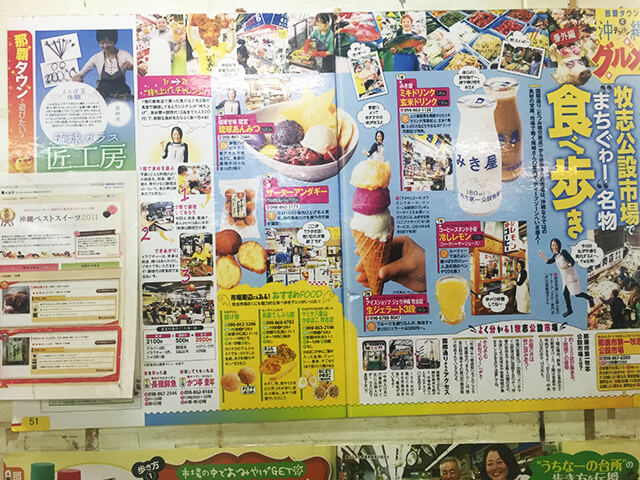
After enjoying Okinawan cuisine, I discovered this map...
Seeing this made me want to eat thunder andagi (Okinawan doughnuts) and fresh gelato, so I went there after my meal!
・Thunder Andagi [Walk]

After enjoying some local cuisine, we hurried to "Ayu," a shop specializing in homemade thunder andagi (Okinawan doughnuts).
Look for the building with its distinctive Okinawan-style red tile roof and yellow sign.

It seems to be a hot topic in various media outlets, including women's magazines and Tabelog (a restaurant review site).
This makes me even more excited to eat it!

Buying nine is more economical, but I wanted to eat them right away, so I bought them individually.
They serve it freshly fried, so you can enjoy it freshly made!

With just one bite, you'll experience a crisp texture and the rich aroma of peanuts fills your mouth. (Made with peanut butter)
It wasn't greasy, so I finished it in no time!
The 5-piece and 9-piece packs have a longer shelf life, making them perfect as souvenirs for family! (They were not individually wrapped.)
• Fresh Gelato [Heart & Berry]

Next, we visited "Heart & Berry," a place whose fresh gelato sounded particularly intriguing.

All of them are tempting flavors.
From mangoes and strawberries to Okinawan bitter melon (goya), they have a variety of options.

After agonizing for three minutes over which one to choose, I finally settled on "mango."
I didn't have much room in my stomach, so I chose the small size this time.

The fresh gelato was made by mixing ice cream, mango pulp, and mango puree on a cold griddle.

While we were making it, we learned about the history of fresh gelato. It's great to know that it has about half the calories of regular ice cream!

Here's the finished product.
It was packed with chunks of mango, and even though it was a small size, it was incredibly satisfying! I thoroughly enjoyed it.
• Currency exchange machines for inbound tourists

What surprised me the most was this foreign currency exchange machine!
It seems to have been made for foreign tourists, but it was always bustling with people using it.
5. Author's thoughts
So far, we've introduced you to Makishi Public Market. What did you think?
Experiencing Okinawa's food culture firsthand made my trip to Okinawa even more enjoyable.
I was also personally happy to discover how delicious Okinawan shallots are and to see Okinawan island fish in person.
If you're ever in the Kokusai-dori area, please be sure to stop by!
【basic information】
Name: Naha City First Makishi Public Market
Address: 2-10-1 Matsuo, Naha City, Okinawa Prefecture 900-0014
Hours: 8: 00 ~ 21: 00
定休日:毎月第4日曜日(12月は除く)、正月(1月1日~3日)、旧盆(旧暦7月13~15日※年によって異なる。8月15~17日)
TEL:098-867-6560
Parking: Coin-operated parking lots are available around Ukishima Street.
Access from Naha Airport: Approximately 15 minutes by car (via National Route 332)
Approximately 10 minutes on foot from Miebashi Monorail Station.
☆Check these out too☆
• [Okinawa/Naha Travel Booking Guide] How to Choose a Hotel, Budget, and Activities
20 Must-Visit Okinawan Spots for Your First Trip to Okinawa
・Map Included | Okinawa Kokusai Street Souvenir List! From classic items to commemorative gifts
Please make your hotel reservation here.
 Rakuten Travel
 Jalan net
Articles from the same area
 Enjoy light and refreshing Okinawan soba noodles with bonito broth at "Soba-dokoro Takaraya," just an 11-minute drive from the airport!
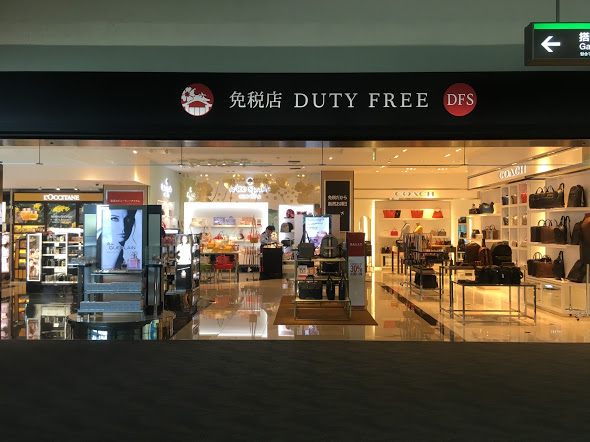 What awaits you after passing through security at Naha Airport? We investigate what lies beyond the gates!
 I went to "Matsumoto," a famous shabu-shabu restaurant, to enjoy some exquisite Agu pork in Okinawa!
 Enjoy tea time at the stylish yet unpretentious "Ohacorte Bakery"!
 I enjoyed some high-quality coffee at "COFFEE potohoto," a coffee bean shop in Sakaemachi Market.
 Okinawa Travel Q&A Starting from Naha Bus Terminal: Bus Stops, Access, and Coin Lockers by Destination
Articles on the same topic
 Ranked #1 in gourmet popularity! Taira Shoten offers a new kind of Yaeyama soba.
 Open only 3 days a week! Kino Store: A sweets shop worth making a special trip for.
 Kamal, authentic Indian cuisine made by Nepalese people | Indian curry in Ishigaki Island?
 Parlor Minato | A budget-friendly parlor located near Kaichu Road
 "GOOD DAY COFFEE" is a cafe in Chatan that is located in a former foreign residence and opens early in the morning at 6:00 AM.
 Enjoy steak on the terrace overlooking the sea at "YONAR'S GARDEN" | Senaga Island Umikaji Terrace Gourmet